Search Engine Optimization is the foundation of sustainable online growth. Learn how modern SEO works, why it matters, and how to align with Google best practices for long-term visibility, authority, and traffic.
Search Engine Optimization is no longer about shortcuts, tricks, or manipulating algorithms. It is a structured, user-first discipline that blends technical precision, high-quality content, and trust signals to help websites earn visibility in competitive search results. In today’s landscape, SEO directly influences brand credibility, customer acquisition, and long-term digital success.
Modern SEO revolves around experience, expertise, authority, and trust. Search engines aim to reward websites that genuinely solve problems, load fast, remain secure, and provide clear value to users. When executed correctly, SEO becomes a compounding asset—delivering consistent traffic without relying on paid ads.
At Appledew, SEO is treated as a strategic growth channel rather than a one-time optimization task. This guide explores how Search Engine Optimization works today, what Google expects from high-quality websites, and how businesses can build sustainable rankings that withstand algorithm updates.
Search Engine Optimization is the process of improving a website’s visibility in organic search results by aligning with how search engines evaluate relevance, quality, and user satisfaction. Unlike paid advertising, SEO focuses on earning placement through value, structure, and trust rather than bidding.
Modern search engines analyze hundreds of ranking signals. These include content relevance, site architecture, mobile usability, page speed, security, and user engagement metrics. According to Google Search Central, SEO should prioritize helping users rather than manipulating search rankings. This marks a clear shift from older practices that relied heavily on keyword repetition or backlinks alone.
SEO today operates across multiple layers: technical foundations, content depth, and authority building. Each layer supports the others. Without a technically sound website, even the best content may struggle to rank. Without helpful content, technical optimization alone cannot sustain visibility. Successful SEO integrates all these elements into a cohesive strategy focused on real users.
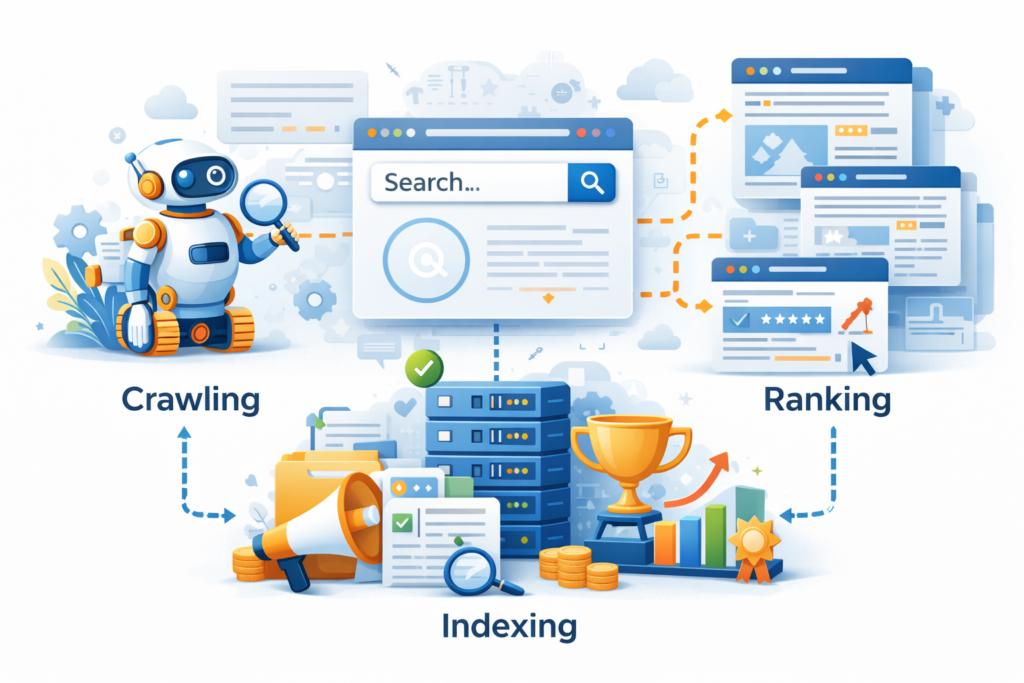
Search engines rely on automated systems to discover, understand, and rank content across the web. This process begins with crawling, where bots scan pages by following links. If a page is inaccessible, poorly structured, or blocked by incorrect settings, it may never be considered for ranking.
Once crawled, content moves to indexing. During this stage, search engines analyze text, images, metadata, and page structure to determine what the page is about. Clear headings, semantic HTML, and descriptive URLs help search engines accurately index content. Google Search Central emphasizes clean structure and accessible content for proper indexing.
Finally, ranking determines where a page appears in search results. Ranking considers relevance to the query, page quality, usability, and trust signals. Pages that demonstrate expertise, load quickly, and provide helpful answers are more likely to appear at the top. Understanding this lifecycle helps businesses optimize the right elements instead of guessing what works.
SEO is one of the few digital strategies that compounds over time. While paid campaigns stop delivering once budgets end, organic visibility continues to drive traffic long after optimization work is complete. This makes SEO a cost-effective channel for sustained growth.
Organic search users often show higher intent. They actively seek solutions, products, or answers. Ranking for relevant keywords allows businesses to meet users exactly when they need help. Research cited by Search Engine Journal shows that organic results earn significantly more trust than paid placements, especially for informational and research-based queries.
Additionally, SEO supports brand authority. Consistently appearing in top results reinforces credibility and familiarity. Over time, this builds trust with both users and search engines. For businesses aiming to scale without relying solely on advertising, Search Engine Optimization becomes an essential long-term investment.
Keyword research is the backbone of effective SEO. It involves identifying the terms users search for and understanding the intent behind those queries. Without this foundation, content risks targeting phrases that attract traffic but fail to convert or rank competitively.
Modern keyword research focuses on search intent, not just volume. Informational, navigational, and transactional queries require different content approaches. Tools such as Ahrefs and Moz help uncover keyword difficulty, related phrases, and user behavior patterns. These insights allow content to align with real user needs.
Beyond primary keywords, incorporating secondary and LSI keywords improves topical depth. This signals relevance without keyword stuffing. Search engines now understand context, synonyms, and semantic relationships, making natural language optimization more important than exact repetition.
On-page SEO refers to optimizations made directly within a webpage to improve relevance and usability. This includes headings, internal linking, metadata, and content clarity. Well-structured pages help both users and search engines understand information efficiently.
High-quality content should demonstrate expertise, answer questions thoroughly, and remain easy to scan. Proper use of H2 and H3 headings, bullet points, and emphasis elements like bold and underline improve readability. According to Google Search Central, clear structure enhances user experience and ranking potential.
Internal linking is another critical on-page signal. Linking related pages helps distribute authority and guide users through relevant topics. When done naturally with exact-match anchor text, internal links strengthen topical relationships without appearing manipulative.
Technical SEO ensures that a website can be crawled, indexed, and rendered correctly. Even exceptional content can underperform if technical issues block search engine access or degrade user experience.
Key technical factors include site speed, mobile responsiveness, HTTPS security, structured data, and clean URLs. Performance optimization is especially important, as page speed directly affects engagement and rankings. Google Developers outlines how fast-loading pages improve both usability and search visibility.
Security is another non-negotiable element. HTTPS encryption protects user data and signals trustworthiness. Providers like Cloudflare emphasize that secure, performant sites reduce bounce rates and improve crawl efficiency. Technical SEO creates the stable foundation that allows all other optimization efforts to succeed.
Search engines prioritize content that demonstrates Experience, Expertise, Authority, and Trust (E-E-A-T). This framework helps distinguish high-quality information from thin or misleading content. Pages written by knowledgeable sources with clear purpose perform better over time.
Content must align closely with search intent. Informational queries require detailed explanations, examples, and clarity. Commercial queries benefit from comparisons, benefits, and transparent information. According to Google Search Central, content should be created primarily for users—not algorithms.
Trust signals such as accurate information, transparent authorship, and reliable references reinforce credibility. By consistently publishing helpful, intent-aligned content, websites build authority that compounds across all SEO efforts.

Link building remains one of the strongest indicators of authority in Search Engine Optimization, but its role has evolved significantly. Today, quality matters far more than quantity. Search engines evaluate where links come from, how relevant they are, and whether they appear natural within meaningful content.
Authoritative backlinks act as trust votes. When reputable websites reference your content, it signals credibility and expertise. According to Ahrefs, high-quality links from topically relevant domains carry substantially more weight than large volumes of low-quality links. This makes strategic outreach and content-driven link earning essential.
Modern link strategies focus on earning links, not building them artificially. Publishing in-depth resources, original research, and expert insights increases the likelihood of organic mentions. Ethical link acquisition protects websites from penalties while strengthening long-term ranking stability.
Local SEO is essential for businesses targeting specific geographic regions. It helps search engines understand where a business operates and who it serves, improving visibility in location-based searches.
Optimizing local presence involves accurate business information, consistent citations, and location-focused content. Google emphasizes proximity, relevance, and prominence when ranking local results, as explained by Google Search Central. Structured data helps search engines interpret local signals more effectively.
User reviews and localized landing pages further strengthen local authority. Businesses that align content with regional intent—while maintaining accuracy and trust—gain a competitive advantage in local search environments.
Mobile-first indexing means search engines primarily evaluate the mobile version of a website when ranking pages. This shift reflects real user behavior, as most searches now occur on mobile devices.
A strong mobile SEO strategy ensures responsive design, fast load times, and intuitive navigation. Core Web Vitals measure real-world user experience signals such as loading speed and visual stability. Google Developers highlights these metrics as essential for ranking performance.
Optimizing for mobile improves accessibility and engagement across all devices. Pages that deliver seamless mobile experiences retain users longer, reduce bounce rates, and send positive quality signals to search engines.
Search engines increasingly evaluate how users interact with content. Metrics like dwell time, bounce rate, and engagement patterns provide insight into whether pages satisfy user intent.
Clear navigation, readable layouts, and logical content flow improve UX. According to Google Search Central, positive page experience contributes to better visibility, especially when relevance is similar across competitors.
UX optimization aligns closely with SEO goals. When users find value quickly and easily, search engines interpret this as content quality, reinforcing higher rankings over time.
SEO is not a one-time effort. Search behavior evolves, competitors improve, and algorithms change. Regular content updates help maintain accuracy, relevance, and authority.
Refreshing content involves updating statistics, improving clarity, and expanding sections to match current intent. Industry insights from Search Engine Journal emphasize that updated content often outperforms newly published pages due to existing authority.
Proactive maintenance ensures long-term visibility. Websites that adapt to algorithm updates instead of reacting defensively experience more stable performance across core updates.
Effective SEO relies on measurement. Tracking performance reveals what works, what needs improvement, and where opportunities exist.
Key metrics include organic traffic, keyword rankings, engagement behavior, and conversion paths. Tools aligned with Google Search Central guidelines help identify crawl errors, indexing issues, and performance trends.
Data-driven optimization allows continuous improvement. By analyzing results consistently, SEO strategies become more precise, scalable, and aligned with business goals.
Website security directly impacts trust and rankings. Search engines prioritize secure environments that protect user data and prevent malicious activity.
HTTPS encryption, protection against vulnerabilities, and regular audits are essential. Security best practices outlined by OWASP help reduce risks that could damage credibility or cause ranking losses.
Trust is cumulative. Secure, reliable websites foster confidence among users and search engines alike, reinforcing long-term SEO strength.
Many websites struggle with SEO due to avoidable mistakes. One common issue is focusing solely on keywords while ignoring user intent. Content that ranks briefly but fails to satisfy users often loses visibility quickly.
Another frequent mistake is neglecting technical foundations. Crawl errors, slow load times, and broken links undermine even high-quality content. According to Google Search Central, technical misconfigurations can significantly reduce indexing efficiency.
Lastly, relying on outdated link-building tactics exposes websites to penalties. Sustainable SEO avoids shortcuts and prioritizes long-term trust over short-term gains.

Successful SEO strategies share common principles. They prioritize users, follow technical standards, and build authority organically. Aligning with best practices ensures resilience against algorithm updates.
Key best practices include publishing expert-driven content, maintaining technical health, optimizing for mobile, and earning authoritative links. Resources from Moz consistently reinforce these fundamentals as cornerstones of long-term success.
SEO works best when treated as an ongoing process. Consistency, quality, and adaptability create compounding returns over time.
Search Engine Optimization is the process of improving website visibility in organic search results by aligning content, structure, and performance with search engine guidelines.
SEO typically shows measurable improvements within three to six months, depending on competition, site condition, and strategy quality.
SEO provides long-term value and trust, while paid ads offer immediate visibility. Both work best when combined strategically.
Content depth matters more than length. Pages should fully satisfy search intent with clarity and relevance.
Yes, but quality and relevance are far more important than quantity.
Google evaluates expertise, relevance, user satisfaction, and trust signals as outlined in Google Search Central.
Yes, but sites aligned with best practices tend to recover faster or remain stable.
Search Engine Optimization is a strategic, long-term investment that blends technical excellence, meaningful content, and genuine trust signals. When executed with discipline and user focus, SEO becomes a sustainable growth engine rather than a volatile tactic.
Businesses that prioritize quality, security, and experience consistently outperform those chasing shortcuts. At Appledew, SEO is approached as a holistic system—built to scale, adapt, and deliver lasting value in an ever-changing search landscape.
You are an expert consultant.
Based on the blog post titled “Search Engine Optimization”, provide a step-by-step, practical implementation guide.
Include tools, best practices, common mistakes to avoid, and advanced tips.
Assume the reader wants to implement everything discussed in this article effectively.
Call to Action:
Want our help implementing this?
Just reach out to us via our website contact form:
https://appledew.com/contact-us/