
Discover how Email Marketing drives engagement, boosts conversions, and builds long-term customer relationships with proven, SEO-optimised strategies.
In today’s competitive digital landscape, email marketing remains one of the most powerful and cost-effective channels for businesses aiming to build lasting relationships with their audience. While social media platforms and paid ads often dominate marketing discussions, email continues to deliver consistent ROI, offering direct access to customers without relying on ever-changing algorithms. Businesses that invest in well-structured email strategies often experience higher engagement, improved customer retention, and increased revenue.
At its core, email marketing is not just about sending messages—it is about delivering value-driven, personalised communication at the right time. Modern consumers expect relevant, timely, and meaningful content. Therefore, successful campaigns rely on data, segmentation, automation, and user behaviour insights. When implemented correctly, email marketing becomes a strategic growth engine rather than just a communication tool.
For businesses looking to establish authority and trust, platforms like Appledew emphasise combining technical excellence with user-focused strategies. This approach ensures that campaigns align with both user expectations and search engine best practices. In this comprehensive guide, we will explore every aspect of email marketing—from foundational concepts to advanced optimisation techniques—helping you create campaigns that truly perform.
Email marketing is a digital marketing strategy that involves sending targeted messages to a group of subscribers via email. These messages can range from promotional offers and newsletters to transactional updates and personalised recommendations. Unlike other channels, email provides a direct and personal line of communication, making it highly effective for nurturing leads and maintaining customer relationships.
One of the key advantages of email marketing is its exceptional return on investment. According to industry benchmarks, email consistently outperforms other marketing channels in terms of cost efficiency. This is largely because businesses own their email lists, unlike social media followers, which are subject to platform changes. As a result, companies have greater control over their audience and messaging strategies.
Additionally, email marketing supports every stage of the customer journey. From awareness and consideration to conversion and retention, emails can be tailored to meet users’ needs at each touchpoint. By leveraging segmentation and behavioural data, businesses can deliver highly relevant content that resonates with their audience. This not only improves engagement but also strengthens brand trust and loyalty over time.
Email marketing has evolved significantly over the years, transitioning from simple bulk messaging to sophisticated, data-driven campaigns. In the early days, marketers focused primarily on sending mass emails with little personalisation. However, as consumer expectations grew and technology advanced, the need for more targeted and relevant communication became evident.
Today, email marketing is powered by automation, artificial intelligence, and advanced analytics. Tools now allow businesses to track user behaviour, segment audiences, and deliver personalised content based on real-time data. This evolution has transformed email marketing into a highly strategic and measurable channel, enabling marketers to optimise campaigns for maximum performance.
Moreover, the rise of mobile devices has reshaped how users interact with emails. With the majority of emails now opened on smartphones, responsive design and mobile optimisation have become essential. Marketers must ensure that their emails are visually appealing, easy to read, and quick to load across all devices. This shift highlights the importance of user experience in modern email marketing strategies.
A successful email marketing strategy is built on several core components that work together to achieve desired outcomes. These include audience segmentation, compelling content, automation workflows, and performance tracking. Each element plays a crucial role in ensuring that campaigns are both effective and scalable.
Segmentation is one of the most critical aspects of email marketing. By dividing your audience into smaller groups based on demographics, behaviour, or preferences, you can deliver more relevant content. This targeted approach increases open rates, click-through rates, and overall engagement. Personalisation further enhances this effect by tailoring messages to individual recipients.
Content quality is equally important. Emails should provide value, whether through educational insights, exclusive offers, or engaging storytelling. Additionally, clear calls-to-action (CTAs) guide users toward desired actions, such as making a purchase or signing up for a service. When combined with automation and analytics, these components create a powerful framework for successful email marketing campaigns.
Creating a high-quality email list is the foundation of any successful email marketing campaign. Unlike purchased lists, which often lead to low engagement and compliance issues, organically built lists consist of users who have willingly subscribed to receive your content. This ensures higher engagement rates and better long-term results.
One effective method for building an email list is offering valuable incentives, such as eBooks, discounts, or exclusive content. These lead magnets encourage users to share their contact information in exchange for something beneficial. Additionally, optimised sign-up forms placed strategically across your website can significantly increase conversions.
It is also important to maintain transparency and comply with data protection regulations. Following guidelines such as General Data Protection Regulation (GDPR) ensures that user data is handled responsibly. Clear consent mechanisms and easy unsubscribe options build trust and demonstrate your commitment to ethical marketing practices.
Creating engaging email content is both an art and a science. The goal is to capture the reader’s attention, provide value, and encourage action—all within a limited space. This requires a deep understanding of your audience and a strategic approach to content creation.
Subject lines play a crucial role in determining whether an email is opened. They should be concise, compelling, and relevant to the recipient. Personalisation, such as including the recipient’s name, can significantly improve open rates. Additionally, preview text should complement the subject line and provide further incentive to open the email.
The body of the email should be clear, engaging, and easy to read. Using short paragraphs, bullet points, and visual elements enhances readability. Strong CTAs guide users toward the desired action, while consistent branding reinforces trust. By focusing on user experience and value, businesses can create emails that drive meaningful results.
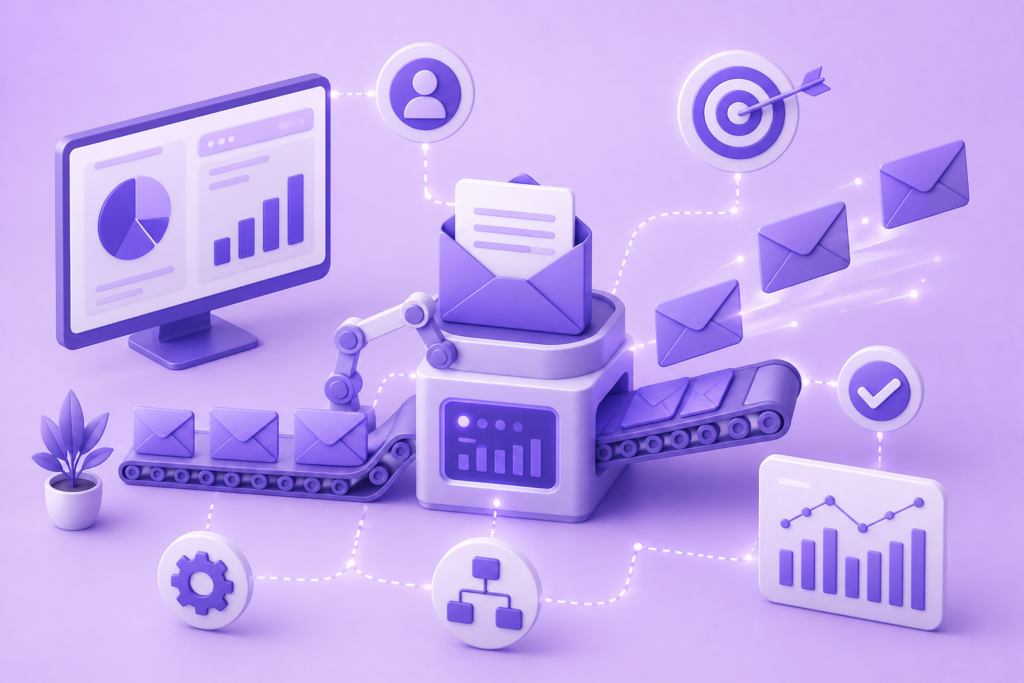
Automation has revolutionised email marketing by enabling businesses to deliver timely and relevant messages without manual intervention. Automated workflows can be triggered by user actions, such as signing up for a newsletter, making a purchase, or abandoning a cart. This ensures that users receive the right message at the right time.
One of the most common applications of automation is the welcome email series. These emails introduce new subscribers to your brand and set the tone for future communication. Similarly, abandoned cart emails remind users of items they left behind, increasing the likelihood of conversion.
Automation also improves efficiency by reducing manual tasks and allowing marketers to focus on strategy and optimisation. Advanced tools provide insights into user behaviour, enabling continuous improvement. By leveraging automation, businesses can scale their email marketing efforts while maintaining a high level of personalisation.
Personalisation and segmentation are essential for creating meaningful connections with your audience. Rather than sending generic messages to your entire list, these techniques allow you to tailor content based on individual preferences and behaviour.
Segmentation involves dividing your audience into groups based on criteria such as age, location, purchase history, or engagement level. This enables more targeted messaging, which leads to higher engagement and conversion rates. Personalisation takes this a step further by customising content for each recipient.
For example, personalised product recommendations based on past purchases can significantly increase sales. Similarly, sending birthday offers or location-specific promotions enhances user experience. By combining segmentation and personalisation, businesses can deliver highly relevant content that resonates with their audience.
Email design plays a crucial role in user engagement and overall campaign performance. A well-designed email not only captures attention but also guides the reader toward the desired action. This requires a balance between aesthetics and functionality.
Responsive design is essential, as a significant portion of emails are opened on mobile devices. Ensuring that emails adapt seamlessly to different screen sizes improves readability and user experience. Additionally, fast loading times and optimised images contribute to better performance.
Accessibility is another important consideration. Following guidelines such as Web Content Accessibility Guidelines (WCAG) ensures that emails are usable by all individuals, including those with disabilities. This not only improves inclusivity but also enhances overall user satisfaction.
Measuring the success of email marketing campaigns requires tracking key performance indicators (KPIs). These metrics provide insights into how well your campaigns are performing and identify areas for improvement.
Open rate, click-through rate (CTR), and conversion rate are among the most important metrics. Open rate indicates how many recipients opened your email, while CTR measures the percentage of users who clicked on a link. Conversion rate reflects the number of users who completed a desired action.
Advanced analytics tools, such as Google Analytics, allow businesses to track user behaviour and measure the impact of email campaigns on website performance. By analysing these metrics, marketers can optimise their strategies and achieve better results over time.
To achieve exceptional results, businesses must go beyond basic campaigns and adopt advanced email marketing strategies that focus on optimisation, behavioural insights, and continuous testing. One of the most effective approaches is A/B testing, which involves experimenting with different subject lines, email designs, and calls-to-action to determine what resonates most with your audience. By analysing the results, marketers can refine their strategies and improve performance over time.
Another powerful strategy is behavioural targeting. This involves sending emails based on user actions, such as browsing behaviour, purchase history, or engagement levels. For example, if a user frequently views a specific product category, you can send targeted recommendations related to that interest. This level of personalisation increases relevance and significantly boosts conversion rates.
Lifecycle email marketing is also essential for maximising ROI. By mapping out the customer journey and creating tailored campaigns for each stage, businesses can nurture leads more effectively. From onboarding sequences to re-engagement campaigns, lifecycle emails ensure that users receive the right message at the right time, ultimately driving long-term growth and customer loyalty.
Compliance is a critical aspect of email marketing that cannot be overlooked. Businesses must adhere to data protection laws and regulations to ensure that user information is handled responsibly. Failure to comply can result in severe penalties and damage to brand reputation. Therefore, understanding and implementing compliance measures is essential for long-term success.
One of the most important regulations is the General Data Protection Regulation (GDPR), which governs how personal data is collected, stored, and used. Businesses must obtain explicit consent from users before sending marketing emails and provide clear information about how their data will be used. Additionally, users should have the option to easily unsubscribe from email communications.
Another key regulation is the CAN-SPAM Act, which sets rules for commercial emails, including requirements for accurate subject lines and sender information. By following these guidelines, businesses can build trust with their audience while avoiding legal complications.
Email marketing does not operate in isolation; it is most effective when integrated with other digital marketing channels. By aligning email campaigns with social media, content marketing, and paid advertising, businesses can create a cohesive and consistent brand experience across all touchpoints.
For instance, email campaigns can be used to promote blog content, driving traffic to your website and increasing engagement. Similarly, social media platforms can be leveraged to grow your email list by encouraging users to subscribe. This cross-channel approach ensures that your marketing efforts are interconnected and mutually reinforcing.
Integration also allows for better data sharing and analysis. By combining insights from different channels, marketers can gain a deeper understanding of user behaviour and preferences. This enables more accurate targeting and improved campaign performance, ultimately leading to better results.
Artificial intelligence (AI) and machine learning are transforming email marketing by enabling more sophisticated and data-driven strategies. These technologies allow businesses to analyse large volumes of data and identify patterns that would be difficult to detect manually.
AI-powered tools can optimise send times, predict user behaviour, and generate personalised content. For example, predictive analytics can determine the best time to send emails to each recipient, increasing the likelihood of engagement. Similarly, AI can recommend products based on past behaviour, enhancing the relevance of your campaigns.
Additionally, machine learning algorithms can continuously learn and improve over time. This means that your email marketing strategy becomes more effective as more data is collected. By leveraging AI, businesses can stay ahead of the competition and deliver highly personalised experiences that drive results.
Despite its effectiveness, email marketing can fail if not executed properly. One of the most common mistakes is sending emails without proper segmentation. Generic messages often fail to engage recipients, leading to low open rates and high unsubscribe rates. Instead, businesses should focus on targeted communication that addresses specific user needs.
Another frequent error is neglecting mobile optimisation. With a large percentage of emails opened on mobile devices, poorly designed emails can result in a negative user experience. Ensuring responsive design and fast loading times is essential for maintaining engagement.
Overloading emails with excessive content or too many calls-to-action is another mistake to avoid. This can overwhelm recipients and reduce the likelihood of conversion. Instead, emails should be concise, focused, and easy to navigate. By avoiding these common pitfalls, businesses can improve the effectiveness of their email marketing campaigns.
Email marketing has proven to be highly effective across various industries. E-commerce businesses, for example, use email campaigns to promote products, recover abandoned carts, and build customer loyalty. These strategies often result in significant increases in revenue and customer retention.
In the B2B sector, email marketing is used to nurture leads and build relationships with potential clients. By providing valuable content and insights, businesses can establish themselves as industry experts and gain the trust of their audience. This ultimately leads to higher conversion rates and long-term partnerships.
Non-profit organisations also benefit from email marketing by using it to engage supporters and drive donations. Personalised storytelling and targeted campaigns can inspire action and create a strong emotional connection with recipients. These examples highlight the versatility and effectiveness of email marketing across different sectors.
To achieve sustainable success, businesses must follow best practices that focus on quality, consistency, and continuous improvement. One of the most important principles is maintaining a clean and engaged email list. Regularly removing inactive subscribers ensures better deliverability and engagement rates.
Consistency in communication is also key. Sending emails at regular intervals helps build familiarity and trust with your audience. However, it is important to strike a balance and avoid overwhelming recipients with too many messages.
Another best practice is continuous optimisation. By analysing performance data and testing different strategies, businesses can identify what works best and refine their approach. This iterative process ensures that email marketing efforts remain effective and aligned with evolving user expectations.
1. What is email marketing?
Email marketing is a digital strategy that involves sending targeted messages to subscribers to promote products, share updates, or build relationships.
2. Why is email marketing important?
It provides a direct communication channel with your audience, offering high ROI and strong engagement compared to other marketing methods.
3. How can I grow my email list?
You can grow your list by offering valuable incentives, optimising sign-up forms, and promoting subscriptions عبر multiple channels.
4. What are the key metrics to track?
Important metrics include open rate, click-through rate, conversion rate, and unsubscribe rate.
5. How often should I send emails?
The frequency depends on your audience and goals, but consistency is more important than volume.
6. What is email automation?
Automation involves sending emails based on triggers or user actions, improving efficiency and personalisation.
7. How can I improve email open rates?
Focus on compelling subject lines, personalisation, and sending emails at optimal times.
8. Is email marketing still effective?
Yes, it remains one of the most effective digital marketing channels when executed correctly.
Email marketing continues to be a cornerstone of successful digital marketing strategies. Its ability to deliver personalised, targeted, and measurable communication makes it an invaluable tool for businesses of all sizes. By implementing the strategies and best practices outlined in this guide, organisations can unlock the full potential of email marketing and achieve sustainable growth.
For businesses aiming to build authority and trust, Appledew provides the expertise and insights needed to create high-performing campaigns. By focusing on user experience, data-driven strategies, and continuous optimisation, email marketing can become a powerful driver of success in today’s digital landscape.
Prompt Text:
You are an expert consultant. Based on the blog post titled “(Email Marketing)”, provide a step-by-step, practical implementation guide. Include tools, best practices, common mistakes to avoid, and advanced tips. Assume the reader wants to implement everything discussed in this article effectively.
Call to Action:
Want our help implementing this? Just reach out to us via our website contact form: https://appledew.com/contact-us/