

Learn how Facebook Ads work, improve audience targeting, manage advertising budgets, create effective campaigns, and increase conversions with proven Facebook advertising strategies.
Facebook Ads has become an important part of digital marketing for businesses that want to reach potential customers, increase brand awareness, generate leads, and drive online sales. Businesses of different sizes can use Facebook advertising to promote products, showcase services, build relationships with customers, and encourage people to take meaningful actions. With the right strategy, advertisers can connect with relevant audiences instead of relying only on organic social media reach.
However, running successful Facebook Ads requires more than creating a promotional post and paying to display it. Advertisers must understand their target audience, select suitable campaign objectives, create compelling advertisements, establish realistic budgets, and measure performance. They also need to consider landing page quality, customer privacy, advertising policies, and the complete customer journey. Without proper planning, businesses may spend money on clicks or impressions that do not contribute to meaningful results.
This comprehensive guide explains how Facebook advertising works and how businesses can develop campaigns that support their marketing goals. It covers audience research, campaign setup, ad formats, creative development, budgeting, bidding, tracking, retargeting, testing, reporting, and optimization. It also explains common mistakes and practical ways to improve campaign performance over time.
At Appledew, the focus is on helping businesses understand digital marketing strategies that are practical, measurable, and aligned with sustainable growth. By following the principles in this guide, marketers and business owners can make more informed advertising decisions, reduce avoidable spending, and build campaigns around genuine customer needs rather than assumptions.
Facebook Ads are paid advertisements that businesses can use to reach people across Facebook and eligible placements within Meta’s advertising ecosystem. Depending on campaign settings and available inventory, ads may appear in feeds, Stories, Reels, and other supported placements. Advertisers manage campaigns through Meta Ads Manager, where they can configure objectives, budgets, audiences, creative assets, placements, and performance measurement. This central platform allows businesses to organize campaigns and compare results against their marketing goals.
The advertising process begins when a business identifies an objective, such as increasing awareness, generating leads, encouraging website purchases, or receiving inquiries. The advertiser then creates a campaign, defines the audience and budget, and prepares the advertisements. Meta’s delivery system uses available signals, campaign settings, and its auction process to determine which eligible advertisements to show. The outcome depends on multiple factors, including the advertiser’s bid strategy, estimated likelihood of the desired action, ad quality, competition, and the available audience. Consequently, advertising costs and results can change over time.
One of the most important features of Facebook advertising is its ability to connect campaign delivery with measurable business objectives. For example, a local service company may want qualified appointment requests, while an online store may focus on purchases and revenue. A new brand may prioritize awareness before expecting immediate sales. These businesses should not evaluate success using the same metrics because their objectives and customer journeys differ. Impressions and reach may help measure awareness, while cost per qualified lead, purchase conversion rate, and return on advertising spend may be more relevant for performance campaigns.
Businesses should also distinguish between the advertising platform and the broader marketing system. An advertisement can attract attention, but the landing page, offer, product quality, pricing, customer service, and checkout experience influence whether that attention becomes a sale. Effective Facebook advertising therefore combines campaign management with a strong customer experience.
For official information about campaign setup and advertising tools, consult the Meta Ads Manager resource. Advertisers should review the platform’s current features and policies because available options, interfaces, and delivery capabilities may change.
Every successful Facebook Ads campaign begins with a clear business goal. Before creating an advertisement, businesses should decide what they want people to do and how that action contributes to broader commercial objectives. Common goals include introducing a brand to new customers, increasing qualified website traffic, collecting inquiries, promoting an event, generating online purchases, and encouraging existing customers to return. A specific goal helps marketers choose the appropriate campaign settings, creative approach, budget, and performance indicators.
The goal should be measurable and realistic. For example, a business that wants more customer inquiries could define a target number of qualified leads within a particular period and establish an acceptable cost per lead. An e-commerce company might measure purchases, revenue, average order value, and return on advertising spend. A brand awareness campaign could evaluate reach, frequency, video views, and relevant engagement. These measurements provide a clearer picture of whether the campaign is achieving its intended purpose than likes or impressions alone.
It is also important to connect campaign goals with the customer journey. People who have never heard of a business may need educational content, demonstrations, customer stories, or an introduction to the problem the product solves. People who already understand the product may respond better to detailed comparisons, testimonials, limited-time offers, or direct purchase opportunities. Matching the advertisement to the audience’s level of awareness can improve relevance and prevent businesses from asking unfamiliar audiences to make decisions before they have enough information.
A practical goal-setting process includes identifying the target outcome, choosing the primary metric, setting a budget, establishing a measurement period, and defining the conditions that would justify making changes. Businesses should also identify secondary indicators that help explain performance. For instance, a low cost per lead may appear positive, but it becomes less useful if most leads are unqualified or never respond to follow-up communication.
Campaign goals should support the company’s wider marketing plan rather than operate independently. Advertising teams should understand how paid social campaigns relate to search marketing, email communication, organic content, sales activity, and customer retention. This approach helps businesses allocate resources based on overall commercial value instead of optimizing a single advertising metric in isolation.
Audience research is one of the foundations of effective Facebook advertising. Before selecting targeting options, businesses should understand the people most likely to benefit from their products or services. This includes their needs, interests, challenges, buying motivations, budget considerations, and reasons for choosing one provider over another. Useful information can come from customer interviews, sales conversations, support requests, website analytics, product reviews, surveys, and existing customer records collected and used appropriately.
Demographic information, interests, and geographic characteristics can help advertisers form an initial understanding of their audience. For example, a neighborhood fitness studio may focus on people within a practical travel distance, while a software company may target a broader business audience. However, audience definitions should reflect actual customer needs rather than stereotypes. A campaign that relies on assumptions about age, income, or interests may exclude potential buyers or attract people who are unlikely to convert.
Businesses should create audience profiles that explain the problems customers want to solve. A home renovation company might discover that prospective customers care about project reliability, transparent pricing, and clear timelines more than attractive design photographs alone. A business software provider might learn that buyers want easier reporting, lower administrative workloads, and dependable support. These insights can guide both targeting decisions and the messages used in advertisements.
Advertisers should also consider the difference between a broad audience and a narrowly defined audience. A narrow audience can be useful when the product serves a specific geographic area or specialist market. However, excessive restrictions may reduce delivery opportunities and make it harder for the advertising system to find suitable customers. Broader targeting can be effective when the campaign objective, creative message, and conversion signals provide sufficient guidance. The best approach depends on the business model, available data, budget, and actual campaign results.
Audience research should continue after launch. Businesses can examine which audience groups generate qualified leads, purchases, repeat orders, or meaningful inquiries. They should evaluate these findings alongside privacy requirements and platform restrictions. Audience performance may change because of competition, seasonal demand, creative fatigue, or shifts in customer behavior. Regular review allows advertisers to update their assumptions and improve campaigns using evidence rather than intuition.
Selecting the correct campaign objective helps align advertising delivery with the action a business wants to encourage. Meta’s advertising system provides objective categories that can support goals such as awareness, traffic, engagement, leads, app promotion, and sales. The exact available settings and optimization options may vary. Advertisers should review the current options in Ads Manager and select the objective that most closely matches the intended result.
The Awareness objective can support campaigns designed to introduce a brand, product, service, or important message to a relevant audience. Businesses may use it when entering a new market, promoting a new location, or increasing recognition before a major launch. Awareness campaigns are generally evaluated using suitable delivery and attention metrics, such as reach, impressions, frequency, and relevant video performance. They should not automatically be judged by immediate purchases if direct sales were not the primary objective.
The Traffic objective is designed to encourage visits to a destination, such as a website or landing page. It may be useful when businesses want people to read an article, explore a service page, or visit a product collection. However, a website visit is not the same as a qualified lead or completed purchase. If the real goal is to generate inquiries or sales and the appropriate conversion measurement is available, advertisers should consider whether a leads or sales objective better reflects that goal.
The Engagement objective may support selected interactions, while Leads can help businesses collect prospective customer information or encourage inquiries through supported methods. Sales is generally relevant when the goal is to encourage purchases or other valuable conversion actions. App promotion campaigns may be suitable for businesses seeking app installs or in-app activity, depending on their setup.
A common mistake is choosing an objective because it appears inexpensive or produces attractive surface-level metrics. For example, a campaign optimized for engagement may generate many reactions but few qualified inquiries. Likewise, a traffic campaign may attract visitors who leave without taking action. Advertisers should evaluate the quality and commercial value of the results rather than assuming that more interactions automatically mean better performance.
Before launching a campaign, write down the intended action, the primary performance indicator, and the conversion event that represents success. This simple exercise creates a clear connection between campaign settings, advertising messages, and business outcomes.
A well-organized campaign structure makes advertising easier to manage, measure, and improve. The process generally begins in Meta Ads Manager, where an advertiser creates a campaign and selects an objective. The campaign level contains settings that apply to the overall initiative, while ad sets typically manage important delivery choices such as audience, schedule, placements, budget configuration where applicable, and optimization settings. Individual ads contain the creative elements people see, including images or videos, copy, headlines, and destination links.
Before launching, advertisers should confirm that the correct business assets are connected and that the appropriate people have access. They should review the business portfolio, advertising account, Facebook Page, Instagram account where relevant, payment method, and permissions. Businesses should avoid sharing personal login credentials and instead use the platform’s available access-management features. This reduces operational risk and makes it easier to maintain control when staff members or agencies change.
Campaign naming conventions can also improve organization. A clear naming structure might identify the objective, product or service, audience type, geographic market, and launch period. For example, a campaign name could indicate that it promotes a local service, targets a specific region, and aims to generate leads. Ad set and ad names should follow a similar pattern. Consistent naming helps teams interpret reports without opening every campaign individually.
Once the structure is ready, advertisers should review the destination URL, creative format, tracking settings, budget, schedule, audience, and call to action. They should also preview advertisements across the intended placements to identify cropping, readability, or layout problems. A creative that looks good in a desktop feed may not work well in a vertical mobile placement. Small errors, such as a broken URL or an outdated offer, can waste budget even when the campaign settings are otherwise correct.
Before publishing, check that the advertisement follows the applicable advertising policies and accurately represents the offer. Avoid unsupported performance claims, misleading prices, deceptive urgency, and creative that implies knowledge of a person’s sensitive personal circumstances. Advertisers should also make sure that the landing page works properly on mobile devices and provides the information promised by the ad.
A final pre-launch review should confirm that the campaign is measurable, the business objective is clear, and the team knows how results will be evaluated. Proper setup will not guarantee success, but it reduces preventable mistakes and provides a more reliable starting point for optimization.

Ad creative is one of the most influential elements of a Facebook advertising campaign because it determines how the message appears to potential customers. Strong creative captures attention, communicates value, and gives people a reason to take the next step. It may include a single image, video, carousel, collection, or another supported format. The best choice depends on the product, campaign objective, audience preferences, and message complexity. Businesses should focus on clarity and relevance instead of assuming that the most elaborate design will produce the best results.
Images work well when a product or service can be explained through a clear visual. For example, a furniture retailer might use high-quality product photography, while a cleaning company could highlight its professional equipment and service process. Video can demonstrate how a product works, explain a complicated service, answer common customer questions, or show a product in everyday use. Carousel ads can present several products, features, or stages of a process within one advertisement. Whatever the format, the creative should communicate the main benefit quickly and remain easy to understand on a mobile screen.
Effective creative combines a clear visual with a relevant message and a suitable call to action. The opening moments of a video should establish why the content matters. The primary text should explain the offer in straightforward language, while the headline should reinforce the central benefit. A call to action such as learning more, contacting the business, or shopping now should match the intended customer journey. Avoid overcrowding images with small text, using confusing layouts, or making exaggerated promises that the business cannot substantiate.
Creative development should also consider the customer’s level of awareness. Someone discovering a brand for the first time may respond to an educational video or a simple explanation of a problem. Someone comparing providers may need proof of quality, transparent pricing, a product demonstration, or genuine customer feedback. Existing customers may respond to relevant new products, complementary services, or loyalty offers. Matching the message to the customer’s needs helps the advertisement feel useful rather than intrusive.
Testing different creative approaches is essential because performance cannot be predicted reliably from design preferences alone. Businesses can compare different opening scenes, images, headlines, offers, and calls to action while keeping the testing conditions reasonably consistent. They should assess meaningful outcomes, such as qualified leads and purchases, instead of selecting a winner based only on reactions or clicks.
For additional guidance, advertisers can review the official Meta advertising standards. Following these standards and presenting accurate information helps businesses build trust, reduce avoidable policy problems, and create a more dependable advertising experience.
Persuasive Facebook ad copy explains why an offer matters to the audience. It should identify a relevant need, communicate a meaningful benefit, and make the next step clear. Businesses do not need complicated language or aggressive sales messages to attract attention. Instead, they should use specific, accurate wording that helps prospective customers understand what is being offered and why it may be useful.
A practical copywriting structure begins with a relevant opening statement, followed by the main benefit, supporting details, and a call to action. For example, a website maintenance company could open with a statement about the importance of keeping a business website secure and reliable. It could then explain the services included, such as software updates, backups, or technical support, provided those services are genuinely available. The advertisement could finish by inviting readers to review the service details or request a consultation. This approach gives potential customers useful information before asking them to act.
Different audiences may respond to different messaging styles. A business selling a complex service may need explanatory copy that answers questions about the process, expected outcomes, and limitations. A retailer promoting a straightforward product may benefit from concise copy that highlights its main features, price, and availability. A local business may emphasize its service area, booking process, or customer support. The tone should match the brand while remaining easy to understand and consistent with the landing page.
Calls to action should be specific and aligned with the campaign objective. A person who needs more information may be comfortable clicking to learn more, while a customer ready to purchase may prefer a direct shopping option. Businesses collecting leads should explain what happens after someone submits a form. If a representative will contact the person, the advertisement or form should communicate that process clearly. Transparency reduces confusion and helps attract people who genuinely understand the offer.
Advertisers should avoid exaggerated claims, fabricated testimonials, misleading discounts, and promises of guaranteed outcomes. They should also be careful with language that appears to assert sensitive personal attributes about the viewer. Advertising copy should focus on the product, service, or general customer need rather than suggesting that the business knows private information about a particular individual.
Finally, copy should be reviewed alongside the visual, headline, call to action, and landing page. These elements should communicate one consistent message. If the ad promises a free consultation but the landing page immediately demands payment, visitors may lose trust. Clear, consistent messaging supports a better customer experience and gives businesses a stronger foundation for improving conversion rates.
Budget management determines how much a business is prepared to spend and how advertising investment is distributed over time. Facebook Ads campaigns may use daily or lifetime budgets, depending on the campaign configuration and available options. A daily budget provides a spending framework for ongoing delivery, while a lifetime budget sets an overall amount for a defined campaign period. The appropriate choice depends on campaign duration, flexibility requirements, business cash flow, and the need to control spending across a schedule.
Businesses should determine their advertising budget from commercial objectives rather than choosing an amount simply because competitors appear to spend more. A useful starting point is to estimate the value of a conversion, the proportion of leads that become customers, the gross profit associated with a sale, and the maximum acquisition cost the business can reasonably support. For example, a service company should consider not only how much it can pay for an inquiry but also how many inquiries typically turn into paying customers. This distinction helps prevent apparently affordable leads from becoming unprofitable.
Bidding and delivery settings influence how the platform competes in advertising auctions. Depending on the campaign, advertisers may have access to approaches that prioritize spending within a budget, control costs, or pursue a target return. These settings are not interchangeable, and their availability can depend on the objective and account configuration. A restrictive cost target may limit delivery if the target is unrealistic for the available audience, competition, or conversion history. Conversely, a less restrictive strategy may spend more freely while pursuing the selected optimization goal. Advertisers should understand the trade-off before changing settings.
Cost per click, cost per thousand impressions, cost per lead, and cost per acquisition are useful measurements, but each describes a different aspect of performance. A low cost per click does not guarantee profitable sales. A higher cost per lead may be acceptable if those leads convert into valuable customers. Likewise, an inexpensive impression may have little business value if the advertisement reaches people who are unlikely to become customers. Businesses should compare costs with conversion quality and revenue whenever reliable data is available.
To manage spending responsibly, advertisers should establish a test budget, define acceptable performance ranges, and review results at planned intervals. They should avoid making frequent changes in response to small fluctuations because limited data can create misleading conclusions. If performance deteriorates, investigate the possible cause before increasing or reducing the budget. The problem could involve creative fatigue, weak landing page performance, poor lead quality, seasonal changes, or tracking errors.
A sound budget strategy protects cash flow while allowing campaigns enough opportunity to produce useful information. Businesses should increase investment when results and capacity justify it, not simply because a campaign has received a large number of impressions or clicks.
Audience targeting helps businesses deliver advertisements to people who are more likely to find their products or services relevant. Facebook advertising provides different targeting approaches, including broad audience targeting, available demographic and interest-based options, custom audiences, and lookalike audiences where supported. The most suitable approach depends on the campaign objective, business model, available customer data, and advertising policies. Instead of trying to identify every potential customer through numerous restrictions, advertisers should build a strategy around genuine customer needs and use campaign results to refine their decisions.
Broad targeting can be useful when a business has a clear offer, suitable creative, and sufficient conversion data to guide campaign delivery. For example, an online store selling everyday home accessories may benefit from allowing the platform to find potential buyers across a reasonably broad audience. By contrast, a local plumbing company may need geographic restrictions because it can only serve customers within a practical distance. Advertisers should apply restrictions that reflect real business requirements while avoiding unnecessary limitations that reduce the opportunity to reach relevant people.
Retargeting focuses on reaching people who have previously interacted with a business in an eligible and permitted way. Depending on available tools, this may include website visitors, people who engaged with a business’s social content, or customers whose information was collected with appropriate permission and used in accordance with applicable requirements. Retargeting can help remind interested people about a product, explain a service in greater detail, or encourage them to complete an unfinished action. However, advertisers must respect privacy requirements and platform rules, including restrictions on sensitive information and the use of customer data.
A practical retargeting strategy separates audiences according to their previous interactions and likely needs. Someone who visited a general blog article may need educational content, while someone who viewed a specific product may benefit from more detailed product information. A person who has already purchased may be better suited to an appropriate complementary offer rather than another advertisement for the same item. Where the tools and consent arrangements permit, businesses can also exclude recent purchasers from campaigns intended only for first-time customers.
Lookalike audiences, where available, can help advertisers find people with characteristics similar to an eligible source audience. Their usefulness depends on the quality and relevance of the source data. A list containing valuable customers may provide a stronger starting point than a list of unqualified inquiries. Nevertheless, similarity does not guarantee purchase intent, so campaign performance must still be evaluated using meaningful business outcomes.
Advertisers should review audience overlap, frequency, lead quality, and conversion rates to avoid wasting budget. They should also verify that audience creation and targeting comply with current platform rules and privacy laws. The goal is not to follow people endlessly across the internet; it is to provide relevant information at an appropriate stage of the customer journey.
Conversion tracking helps advertisers understand whether their campaigns lead to meaningful actions. Depending on the business, these actions may include completed purchases, submitted lead forms, appointment bookings, qualified inquiries, or other valuable events. Without reliable measurement, advertisers may see clicks and impressions but struggle to determine which campaigns contribute to actual business results. A well-designed tracking system connects advertising activity with website behavior and, where possible, the outcomes recorded by the sales team.
Meta Pixel is a browser-based measurement tool that can help businesses measure certain website actions and support advertising-related features when implemented correctly. The Conversions API provides a server-to-server method for sharing eligible event information with Meta. Depending on the website, technology stack, and implementation, businesses may use one or both approaches. Their configuration requires care because incorrect event setup, duplicate events, missing consent controls, or inaccurate values can undermine reporting. Advertisers should follow the relevant documentation and ensure that their implementation respects applicable privacy requirements.
Before launching a campaign, businesses should define the events that matter and test whether those events are recorded accurately. An online store might measure product views, add-to-cart actions, checkout activity, and purchases. A service provider might track successful form submissions or completed bookings. Each event should represent the intended action clearly. For example, a page view on a thank-you page should not automatically count as a qualified lead if visitors can access that page without completing the form.
Advertisers should also distinguish between platform-reported conversions and the complete business record. Different measurement systems can report different results because of attribution settings, consent choices, browser restrictions, reporting windows, modeled data, and other technical factors. A campaign report should therefore be reviewed alongside website analytics, customer relationship management records, order data, or sales reports where available. Differences between systems should be investigated rather than resolved by automatically trusting whichever platform reports the highest number.
Important performance metrics include cost per result, conversion rate, cost per acquisition, average order value, revenue, and return on advertising spend. Return on advertising spend, often shortened to ROAS, compares attributed revenue with advertising expenditure. It does not automatically account for product costs, refunds, shipping, staff expenses, or other operating costs. Businesses should therefore evaluate ROAS alongside profit margins and customer acquisition costs to understand whether advertising contributes to sustainable growth.
For technical implementation guidance, consult the official Meta Conversions API documentation and Google Analytics documentation. These resources can help teams establish more reliable measurement practices. Accurate tracking is not simply a reporting task; it is the foundation for making better budget and optimization decisions.
A/B testing allows advertisers to compare different versions of a campaign element to learn which approach produces better results. Businesses can test images, videos, headlines, primary text, offers, landing pages, or audience strategies. However, a useful test requires a clear question and a measurement method that reflects the campaign objective. If the purpose is to generate qualified leads, selecting a creative solely because it receives more likes may lead to the wrong conclusion.
The first step is to establish a hypothesis. For example, an online retailer might believe that a product demonstration video will produce more purchases than a static product image. The business can compare these approaches while keeping other important conditions as consistent as possible. If the objective is to identify the effect of a headline, changing the headline alone is generally easier to interpret than changing the headline, audience, offer, and landing page simultaneously. Where available, formal experiment tools can help create a more controlled comparison.
A meaningful test also needs sufficient data. Small numbers of conversions can produce large percentage swings that disappear when more results become available. Advertisers should consider conversion volume, expected variation, campaign duration, and the practical cost of collecting enough information. They should avoid declaring a winner simply because one version performs better during a short period. At the same time, businesses do not need to run every test indefinitely. A test should have a clear decision rule and a reasonable stopping point.
After identifying a promising result, advertisers should examine the quality of the conversions. A creative that generates inexpensive inquiries may attract people who are not ready to buy. Another creative may generate fewer inquiries but produce more paying customers. The second approach could be more valuable even if its cost per lead appears higher. Sales feedback, customer value, and conversion rates should therefore inform optimization decisions whenever possible.
Continuous optimization involves more than testing advertisements. Businesses should review the full customer journey, including the offer, landing page, mobile experience, form length, page speed, payment process, and follow-up communication. If an ad attracts qualified visitors but few people complete the form, the problem may be on the website rather than in the creative. If many people submit forms but never respond, the business may need to improve its qualification questions or follow-up process.
Maintain a record of each test, including the hypothesis, variations, dates, budget, audience conditions, results, and decision. This creates a useful learning history and reduces the risk of repeating unsuccessful experiments. Over time, systematic testing helps advertisers develop a stronger understanding of customer behavior and make decisions based on evidence rather than personal preference.
The landing page is the destination where people arrive after clicking an advertisement. It plays a major role in determining whether advertising traffic becomes a lead, booking, or sale. A relevant advertisement may attract a potential customer, but a confusing page, unclear offer, slow loading time, or difficult checkout can prevent that person from completing the intended action. Landing page optimization should therefore be treated as an essential part of Facebook advertising rather than a separate technical concern.
The first principle is message consistency. The landing page should deliver what the advertisement promises. If an ad promotes a particular product discount, visitors should be able to find the offer easily and understand its conditions. If an advertisement invites people to request a consultation, the page should explain the service and provide a straightforward way to submit an inquiry. Visitors should not have to search through unrelated content to find the information that persuaded them to click.
A strong landing page typically includes a clear headline, a concise explanation of the offer, relevant benefits, credible supporting information, and an obvious call to action. Depending on the product, it may also need pricing, specifications, delivery information, service coverage, customer reviews, or answers to common questions. Claims should be accurate and verifiable. Testimonials must be genuine, and any conditions attached to discounts or guarantees should be presented clearly. A page that uses misleading claims to increase short-term conversions can damage customer trust and create legal or policy risks.
Mobile usability deserves particular attention because many people encounter social advertisements on mobile devices. Pages should display correctly on smaller screens, use readable text, provide appropriately sized controls, and minimize unnecessary steps. Forms should request only the information needed for the intended purpose. A lengthy form may discourage visitors who would otherwise submit an inquiry, while a form that collects too little information may generate leads that are difficult to qualify. Businesses should find a reasonable balance between completion rates and lead quality.
Page speed and technical reliability also influence the experience. Broken links, oversized images, intrusive pop-ups, checkout errors, and unexpected redirects can undermine campaign performance. Teams should test landing pages on common mobile devices, review form submissions, verify payment or booking flows, and monitor performance after website changes. Google’s PageSpeed Insights can help identify opportunities to improve page performance, while Core Web Vitals explains important user-experience measurements.
To evaluate landing page performance, compare advertising clicks with landing page visits, completed forms, purchases, and other relevant actions. A large difference between clicks and actual visits may indicate loading problems or measurement differences. A low conversion rate may suggest that the offer, message, page design, or audience needs further investigation. Improving the complete experience can make existing advertising traffic more valuable without automatically increasing the budget.
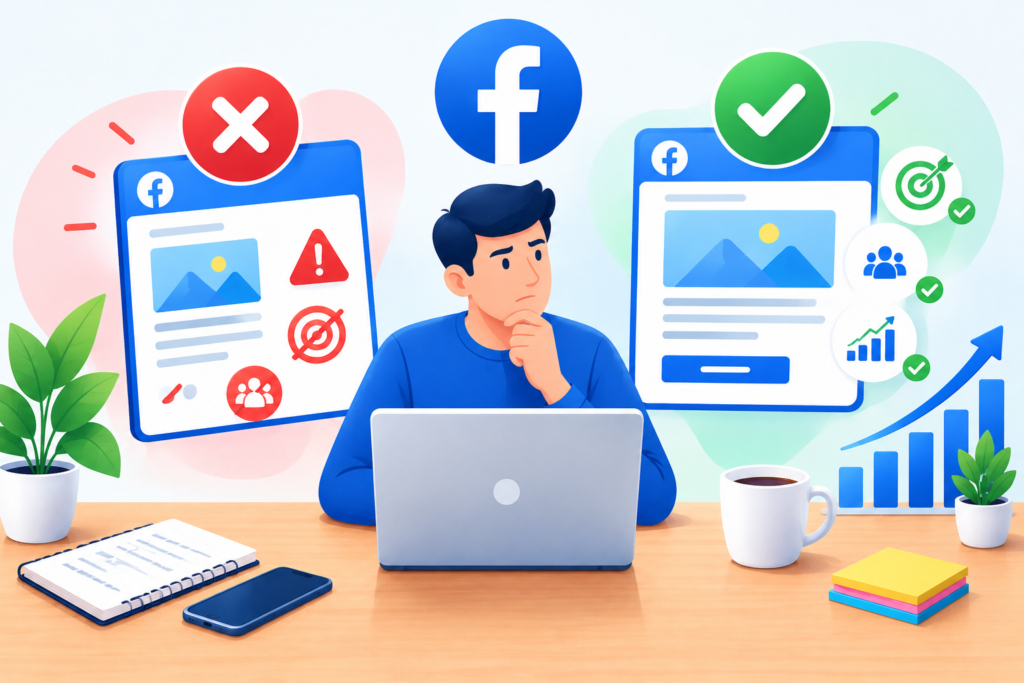
Many Facebook advertising campaigns underperform because of avoidable planning, creative, measurement, or management mistakes. One common problem is launching campaigns without a clearly defined business objective. When advertisers focus on obtaining likes, impressions, or inexpensive clicks without considering customer acquisition or revenue, they may spend money without producing meaningful business results. To avoid this problem, define the desired outcome before launch and select performance indicators that measure progress toward that outcome.
Another frequent mistake is targeting audiences too narrowly or making assumptions about customer interests without supporting evidence. Excessive restrictions can limit delivery opportunities, while overly broad targeting may be ineffective when the business has geographic or specialist requirements. Advertisers should begin with a reasonable audience strategy, use genuine customer insights, and review the quality of actual results. They should also avoid creating numerous small ad sets that divide a limited budget and make meaningful comparisons difficult.
Poor creative quality can also waste advertising expenditure. Low-resolution images, confusing videos, unclear headlines, weak offers, and irrelevant messages make it harder for people to understand the value of an advertisement. Some businesses repeatedly use the same creative until engagement declines, while others change advertisements so frequently that they never collect enough useful data. A better approach is to develop several relevant creative concepts, monitor performance, and refresh content when there is evidence of declining effectiveness.
Incorrect tracking is another serious issue. If purchase events are missing, lead submissions are counted more than once, or conversion values are inaccurate, campaign reports may lead advertisers toward poor decisions. Businesses should test their tracking setup before launch, review unusual changes in reported results, and compare platform data with independent business records where possible. They should also respect consent requirements and avoid sending unnecessary personal information through tracking systems.
Landing page problems can reduce the value of otherwise successful advertisements. Slow loading, broken forms, inconsistent pricing, poor mobile usability, and complicated checkout processes may cause visitors to abandon the journey. Advertisers should test the complete experience before spending money and repeat those checks after significant website updates. Improving the landing page may be more effective than continually changing the campaign.
Other common mistakes include making large budget changes without reviewing performance, ignoring lead quality, failing to exclude irrelevant audiences where appropriate, and expecting immediate profitability from every campaign. Advertising results can fluctuate because of competition, seasonality, customer demand, and delivery conditions. Businesses should make measured adjustments based on sufficient evidence.
Finally, advertisers should not rely on misleading claims, fake urgency, fabricated reviews, or prohibited targeting practices to improve results. These tactics can damage trust and create compliance problems. A sustainable strategy focuses on accurate communication, reliable measurement, useful offers, and a consistent customer experience.
Facebook Ads are paid advertisements managed through Meta’s advertising tools. Businesses select a campaign objective, define the appropriate audience and budget, create advertisements, and choose available delivery settings. The platform then delivers eligible ads through its advertising auction system. Results depend on factors such as the objective, competition, creative quality, audience relevance, and the likelihood of the intended action. Businesses can measure performance using available reporting tools and properly configured conversion tracking.
There is no single fixed price for Facebook advertising. Costs depend on factors such as audience competition, campaign objective, placement, creative performance, geography, and time of year. Advertisers can establish a budget that fits their resources, but a small budget may take longer to generate enough conversions for reliable evaluation. Before launching, estimate the value of a customer, the acceptable acquisition cost, and the amount the business can afford to spend while testing its approach.
Yes. Facebook advertising can be suitable for small businesses that have a clear offer and a realistic plan for measuring results. A local service provider can focus on its service area, while an online business may reach customers across a wider market. Small businesses should start with a manageable budget, use relevant creative, and track meaningful outcomes. They should also ensure that they can handle the inquiries, orders, and customer service activity generated by a successful campaign.
A boosted post is an existing or newly published social media post that receives paid distribution through available promotion options. Ads created and managed through Meta Ads Manager provide more structured campaign management, including a broader selection of objectives, audience settings, creative options, and measurement features where supported. Boosted posts can be useful for simple promotional needs, while Ads Manager is generally more suitable for businesses that need detailed campaign organization and performance optimization.
Some campaigns may generate clicks or inquiries shortly after launch, but meaningful performance evaluation often requires more time and sufficient data. The appropriate period depends on the budget, audience size, conversion volume, sales cycle, and campaign objective. Businesses should avoid judging success from a few early interactions. Instead, they should establish a reasonable evaluation period, monitor delivery and tracking, and make changes when there is enough evidence to support a decision.
A good cost per lead depends on the business’s profit margins, sales conversion rate, average customer value, and operating costs. A lead that costs more may still be valuable if it has a much higher likelihood of becoming a customer. Conversely, a cheap lead can be unprofitable if the person is not genuinely interested or does not meet the business’s requirements. Calculate acceptable acquisition costs and assess lead quality, not just the number of form submissions.
Retargeting involves showing eligible advertisements to people who have previously interacted with a business, subject to the platform’s features and applicable privacy requirements. These interactions might include visiting a website, engaging with social content, or viewing certain products. Retargeting can remind potential customers about an offer or provide additional information that supports a decision. It should be used thoughtfully, with suitable audience exclusions, relevant creative, and appropriate data permissions.
Businesses can improve conversion rates by matching advertisements to the right audience, communicating a clear benefit, using strong creative, and sending visitors to a relevant landing page. They should also ensure that forms and checkout processes work properly on mobile devices. Conversion tracking helps identify where people leave the customer journey, while controlled testing can reveal which changes produce better outcomes. The most effective improvements depend on the actual performance problem rather than a universal formula.
Return on advertising spend measures the revenue attributed to advertising relative to the amount spent on ads. For example, if a business records $2,000 in attributed revenue from $500 in advertising expenditure, its ROAS is 4:1. However, this does not mean the business earned $1,500 in profit. Product costs, fulfillment, salaries, software, refunds, taxes, and other expenses may reduce the final result. Businesses should evaluate ROAS alongside contribution margin and overall profitability.
No. Depending on the campaign objective and available features, businesses may use supported lead forms, messaging experiences, app destinations, or other permitted destinations. However, a website can provide greater control over product information, customer education, analytics, and conversion processes. The best destination depends on the offer and the intended customer action. Regardless of the destination, advertisers should explain the offer clearly and make the next step easy to complete.
Successful Facebook advertising depends on consistent planning, relevant creative, reliable measurement, and disciplined optimization. Businesses should begin with a clear understanding of the customer problem they want to solve and the action they want their advertisements to generate. Each campaign should have a defined objective, a suitable audience strategy, a realistic budget, and performance indicators that reflect business value. These fundamentals help prevent advertising decisions from being driven by vanity metrics or short-term fluctuations.
Creative quality should remain a priority throughout the campaign. Advertisements should communicate their value quickly, use clear and accurate language, and provide a call to action that matches the customer journey. Images and videos should be suitable for their intended placements, while headlines and primary text should remain consistent with the offer. Businesses should test different creative approaches and use actual results to guide future development. They should also refresh content when performance indicates that the current message is losing effectiveness.
Measurement and technical reliability are equally important. Advertisers should verify their tracking implementation, test conversion events, review landing pages, and compare platform reporting with relevant business records. Privacy and data protection should be built into the measurement process rather than addressed only after a problem occurs. Clear access controls, accurate event configuration, and responsible data handling support a more dependable advertising operation.
Budget decisions should be based on customer value, campaign performance, and the business’s ability to fulfill demand. A low cost per click is not automatically a good result, and a high volume of leads does not guarantee revenue. Evaluate the quality of conversions and understand the relationship between advertising expenditure, sales, and profit. Increase spending gradually when results support expansion and the business can handle additional customers.
Use the following checklist when reviewing a campaign:
The strongest advertising strategy is not necessarily the one with the largest budget. It is the one that consistently connects the right message with relevant customers, measures results honestly, and uses evidence to improve performance. By applying these practices, businesses can develop a more structured approach to Facebook Ads and make more informed decisions as their campaigns evolve.
Facebook Ads can help businesses build brand awareness, attract potential customers, generate qualified leads, and increase sales when campaigns are planned and managed effectively. However, consistent results require more than choosing an audience and publishing an advertisement. Businesses must understand customer needs, develop compelling creative, select suitable campaign objectives, manage budgets carefully, and measure the outcomes that matter most.
A strong advertising strategy also considers the complete customer journey. Relevant advertisements need reliable landing pages, clear offers, straightforward conversion processes, and appropriate follow-up. Tracking and analytics help businesses understand what is working, while systematic testing reveals opportunities for improvement. By reviewing performance regularly and making evidence-based adjustments, advertisers can reduce avoidable spending and build more effective campaigns over time.
At Appledew, the goal is to help businesses understand digital marketing approaches that support measurable and sustainable growth. Whether you are starting your first campaign or improving an established advertising strategy, focus on customer value, transparent communication, responsible measurement, and continuous learning. These principles provide a practical foundation for making better Facebook advertising decisions.
Prompt Text
You are an expert consultant. Based on the blog post titled “(Facebook Ads)”, provide a step-by-step, practical implementation guide. Include tools, best practices, common mistakes to avoid, and advanced tips. Assume the reader wants to implement everything discussed in this article effectively. Copy Implementation Prompt
Call to Action
Want our help implementing this? Just reach out to us via our website contact form: https://appledew.com/contact-us/