Discover how email marketing helps businesses attract customers, build lasting relationships, increase conversions, and drive sustainable growth through effective campaigns, automation, and personalised communication.
Email marketing remains one of the most effective digital marketing channels for businesses that want to communicate directly with their audiences, build customer relationships, and generate consistent revenue. Although social media, paid advertising, and search engine marketing receive significant attention, email continues to offer businesses an important way to reach people who have already shown interest in their products, services, or content. A well-planned email marketing strategy allows companies to deliver useful information, promote relevant offers, share updates, and encourage customers to take meaningful actions.
Modern email marketing involves much more than sending promotional messages to a large contact list. It combines audience research, customer segmentation, persuasive copywriting, attractive email design, marketing automation, and performance measurement. Businesses can use these elements to create relevant experiences at every stage of the customer journey. For example, a new subscriber may receive a welcome email, an interested prospect may receive educational content, and an existing customer may receive product recommendations or helpful service updates. This structured communication helps businesses remain connected with their audiences without depending entirely on paid advertising or social media algorithms.
At Appledew, the focus is on helping businesses understand digital marketing opportunities and use effective strategies to improve their online presence. Email marketing can support these goals by creating direct communication channels between companies and their customers. However, successful campaigns require clear objectives, permission-based subscriber lists, useful content, reliable delivery systems, and continuous improvement. Businesses must also respect privacy requirements and follow email service provider guidelines. This complete guide explains how email marketing works, how to develop an effective strategy, how to create engaging campaigns, and how to measure results. It also explores automation, personalisation, deliverability, common mistakes, and practical techniques that businesses can use to achieve sustainable marketing growth.
Email marketing is a digital communication strategy that allows businesses to send messages to people who have agreed to receive information from them. These messages can include promotional offers, educational articles, company announcements, product updates, newsletters, event invitations, and customer support information. Unlike many other digital marketing channels, email gives businesses a direct way to communicate with subscribers through their inboxes. This makes it useful for developing relationships, maintaining customer engagement, and encouraging repeat purchases. However, effective email marketing depends on delivering messages that provide genuine value rather than repeatedly sending advertisements without considering the recipient’s interests.
The process usually begins when someone subscribes through a website form, landing page, checkout process, or another permission-based registration method. Their contact information is stored in an email marketing platform, where the business can organise subscribers and manage communication preferences. Marketing teams can then prepare campaigns, write messages, design email templates, and schedule delivery. Once an email is sent, the platform records available performance information, such as deliveries, clicks, bounces, and unsubscribes. Businesses can use this information to understand how subscribers respond and identify areas that need improvement. For example, if a newsletter receives many clicks on educational articles but very few clicks on product pages, the business may need to improve the connection between its informational content and its commercial offers.
Email marketing works best when every message has a clear purpose. A welcome email should introduce the business and explain what subscribers can expect. An educational email should solve a specific problem or answer an important question. A promotional email should communicate an offer clearly and explain why it is relevant. A customer retention email should help existing customers receive more value from a product or service. These different message types create a communication system that supports the entire customer lifecycle. Businesses should also understand the difference between marketing emails and transactional emails, such as order confirmations and password reset notifications. Each category serves a different purpose and may have different technical and legal requirements. By combining useful content, responsible subscriber management, and appropriate campaign planning, companies can build an email marketing programme that supports long-term business objectives.
Email marketing is important because it provides businesses with a direct communication channel that can support customer acquisition, engagement, conversion, and retention. Companies often invest in search engine optimisation, paid advertising, social media marketing, and website development to attract visitors. However, attracting visitors is only one part of business growth. Organisations also need ways to maintain relationships with interested people after their first interaction. Email marketing helps solve this challenge by allowing businesses to communicate with subscribers after they leave a website. Instead of relying on someone to remember a brand or return through a search engine, companies can share relevant information and useful updates directly with their audience.
Another important advantage is the ability to create targeted communication. Businesses do not need to send identical messages to every subscriber. They can organise contacts according to interests, previous purchases, engagement levels, and customer lifecycle stages. For example, an online store can send product education to new customers, special recommendations to returning customers, and relevant reminders to subscribers who have shown interest in a particular category. A professional service company can share case studies, industry insights, service explanations, and appointment reminders with different audience groups. This approach makes communication more useful and reduces the likelihood that subscribers will receive irrelevant messages. It also allows smaller businesses to build structured marketing activities without requiring a large advertising budget.
Email marketing can also contribute to measurable business performance. Marketing teams can evaluate how many messages were delivered, how many recipients clicked links, which campaigns generated website visits, and which activities contributed to leads or sales. These insights help companies understand whether their communication supports business objectives. However, businesses should not treat every open or click as proof of commercial success. Privacy features, automated scanning, and email client behaviour can affect tracking data. Revenue, qualified enquiries, conversions, retention, and customer lifetime value often provide stronger evidence of business impact. When email campaigns are connected with website analytics and customer relationship management systems, businesses can understand how subscribers move from initial interest to meaningful action. This makes email marketing a valuable part of a broader digital marketing strategy rather than an isolated promotional activity.
A successful email marketing programme begins with a clear strategy. Businesses should first identify what they want email communication to achieve. Some organisations want to generate qualified leads, while others focus on increasing online sales, improving customer retention, promoting new services, or building brand awareness. These objectives influence the type of messages a business sends, the audience it targets, and the performance indicators it monitors. Without clear objectives, email marketing can become a collection of disconnected campaigns that produce activity without delivering meaningful business results. A practical strategy connects every campaign to a specific purpose and explains how that campaign contributes to wider marketing goals.
The next step is understanding the target audience and the problems it wants to solve. Businesses should research customer needs, purchasing behaviour, common questions, preferences, and reasons for choosing particular products or services. This information can come from customer interviews, website analytics, support conversations, surveys, sales records, and previous campaign results. For example, a software company may discover that potential customers are more interested in understanding product features than receiving discount announcements. A service provider may find that prospects need pricing information, examples of previous work, and clear explanations of the service process before contacting the company. These findings help marketing teams create content that addresses genuine concerns instead of relying on assumptions.
A strong email marketing strategy should also include a communication schedule, content plan, budget, platform selection, and measurement framework. Businesses should decide how frequently they will send emails, what topics they will cover, which subscriber groups will receive each campaign, and how they will evaluate performance. Sending frequency should reflect audience expectations and the value of the content rather than an arbitrary daily or weekly target. A simple monthly calendar can help teams plan newsletters, product announcements, educational campaigns, seasonal promotions, and automated messages. It is also useful to define key performance indicators before launching campaigns. These may include conversion rate, click-through rate, qualified leads, revenue per recipient, unsubscribe rate, and list growth. Regular reviews allow businesses to identify successful approaches, correct weak campaigns, and adjust their strategy as customer expectations change.
Understanding the target audience is essential because effective communication begins with knowing who receives each message and what information is relevant to them. A business may offer several products or services, but not every subscriber will have the same needs. Some people may be researching a problem, others may be comparing solutions, and some may already be ready to purchase. Sending the same message to all these individuals can reduce engagement because the content may not match their current interests. Audience research helps businesses identify meaningful differences between subscribers and create communication that reflects their needs, preferences, and decision-making processes.
Businesses can develop audience profiles by examining demographic information where appropriate, professional roles, interests, purchasing behaviour, website activity, and previous interactions. For business-to-business marketing, useful characteristics may include industry, company size, job responsibility, and the challenges faced by decision-makers. For consumer marketing, relevant information may include product preferences, previous orders, location where necessary, and preferred communication topics. However, companies should collect only information that serves a clear business purpose and should handle personal data responsibly. It is not necessary to ask subscribers for excessive details during registration. A short subscription form that requests an email address and perhaps one relevant preference can often provide a better experience than a long form that discourages people from joining.
Customer research should continue after the initial subscription. Businesses can use surveys, preference centres, customer feedback, website behaviour, and campaign engagement to improve their understanding of subscriber needs. For instance, a digital agency might discover that some subscribers want practical website maintenance advice, while others are interested in search engine optimisation or paid advertising. The agency can use these preferences to organise its content and make future communication more relevant. It should also recognise that interests change over time. A subscriber who initially wants educational information may later become interested in purchasing a service. Reviewing audience behaviour regularly helps businesses adapt their messaging without making unsupported assumptions. When audience research guides email content, subscribers are more likely to receive information that is useful, timely, and connected to their actual interests.
A high-quality email list is one of the most important assets in an effective email marketing programme. However, list quality is more important than simply collecting a large number of addresses. A business with a smaller group of genuinely interested subscribers may achieve better engagement and more meaningful conversions than a company that sends messages to thousands of people who never requested them. Permission-based list building ensures that people understand why they are providing their contact information and what type of communication they can expect. This creates a stronger foundation for trust, improves audience relevance, and reduces the risks associated with unwanted messages.
Businesses can build subscriber lists through website registration forms, valuable downloadable resources, newsletter invitations, event registrations, webinars, and relevant landing pages. For example, a website development company could offer a practical website maintenance checklist in exchange for an email subscription. An online retailer might invite customers to receive product updates, buying guides, and special offers. A professional consultant could provide an educational email series explaining common industry challenges. These offers should deliver genuine value and clearly explain what subscribers will receive. Subscription forms should use understandable language, avoid misleading statements, and make consent choices clear. Businesses should never purchase email lists or collect addresses through scraping and then treat those contacts as subscribers. Such practices can damage sender reputation and create legal and privacy risks.
List management is just as important as list growth. Businesses should use confirmation processes where appropriate, monitor invalid addresses, remove hard bounces, and maintain accurate subscription records. They should also provide a simple way for subscribers to update their preferences or unsubscribe. An effective list-building process includes a clear privacy notice, an identifiable sender, and an explanation of expected communication frequency. As a list grows, businesses should review its source and engagement quality rather than focusing only on the total number of contacts. A healthy subscriber list is made up of people who understand the relationship, want to receive relevant messages, and have a straightforward way to control their preferences. This creates a more sustainable foundation for email marketing campaigns and helps businesses maintain better communication standards.
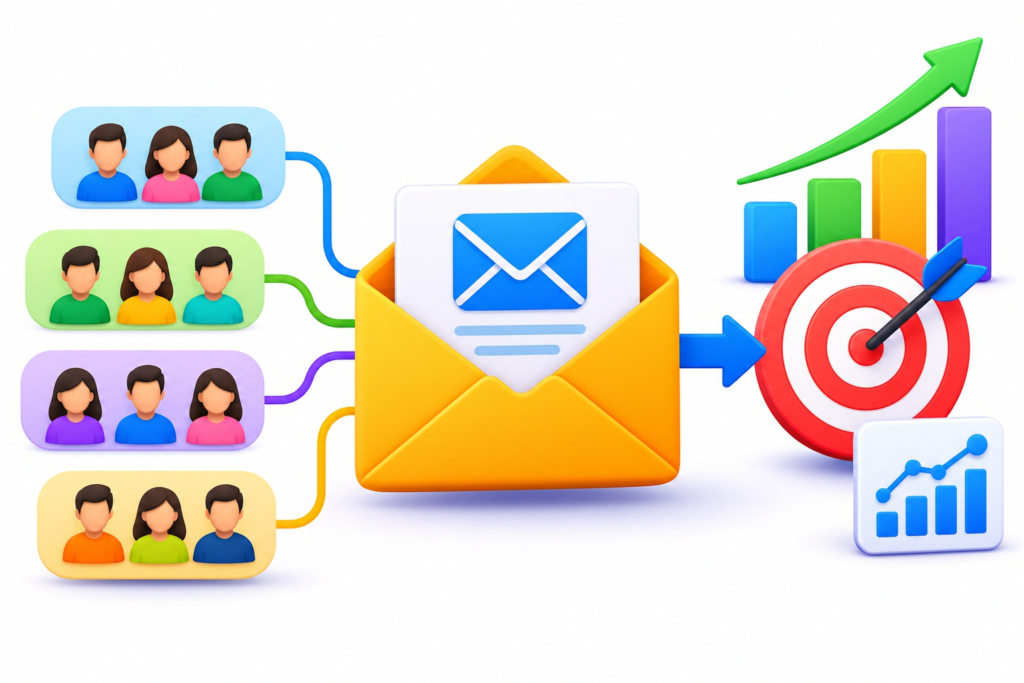
Email segmentation is the process of dividing a subscriber list into smaller groups based on shared characteristics, interests, behaviours, or relationships with a business. It allows marketing teams to send more relevant messages instead of treating every subscriber as if they had identical needs. Segmentation is especially useful when a company serves multiple customer groups or offers a wide range of products and services. For example, an online store selling clothing, electronics, and home accessories may have subscribers interested in completely different product categories. Sending every product announcement to the entire list could create unnecessary inbox clutter. Creating separate audience groups helps the business deliver information that is more closely connected to individual interests.
There are several ways to segment an email audience. Demographic segmentation may organise subscribers by broad characteristics when those details are relevant and appropriately collected. Behavioural segmentation uses actions such as previous purchases, product page visits, email clicks, and content downloads. Engagement-based segmentation identifies subscribers who regularly interact with campaigns and those who have become inactive. Customer lifecycle segmentation separates new subscribers, potential customers, first-time buyers, repeat customers, and long-term customers. Preference-based segmentation allows people to select the subjects or types of communication they want to receive. Each method provides a different perspective on the audience, and businesses can combine multiple criteria when there is a clear reason to do so.
Effective segmentation requires accurate data and regular maintenance. A segment should represent a meaningful group rather than a complicated collection of conditions that the marketing team cannot maintain. Businesses should begin with a few useful categories, test different messages, and expand their segmentation approach as they learn more about subscriber behaviour. For example, a company may compare the performance of educational content sent to new subscribers with product-focused content sent to existing customers. If the results show that different groups respond to different types of information, the company can adjust its communication plan accordingly. Segmentation should also respect subscriber preferences and applicable privacy rules. Personal information should not be collected or used without an appropriate purpose. When implemented carefully, email segmentation improves relevance, supports stronger customer relationships, and helps businesses make better use of their marketing resources.
Businesses can use several types of email marketing campaigns depending on their objectives, audience expectations, and customer relationships. Each campaign serves a different purpose, so choosing the correct format is important. A newsletter, for example, is designed to maintain regular communication by sharing educational articles, company updates, industry news, and useful resources. Promotional emails focus on specific products, services, discounts, or limited-time offers. Welcome emails introduce new subscribers to a business, explain its services, and establish expectations for future communication. Choosing the right campaign type helps marketing teams deliver appropriate information instead of sending unrelated promotional messages.
Welcome email campaigns are particularly important because they create the first direct communication after someone subscribes. A good welcome email should thank the subscriber, explain what they can expect, and provide a useful next step. Educational email campaigns help businesses demonstrate expertise by sharing tutorials, practical advice, industry insights, and solutions to common problems. Promotional email campaigns introduce relevant offers and encourage customers to make purchasing decisions. Product announcement emails communicate new releases, feature improvements, and important product information. Re-engagement campaigns attempt to reconnect with subscribers who have stopped interacting with previous messages. Businesses can also use abandoned-cart emails, post-purchase messages, customer feedback requests, and event invitations to support different stages of the customer journey. Every campaign should have a clear objective and a relevant message.
Another important category is automated transactional communication. These messages include order confirmations, payment receipts, shipping notifications, account updates, and password reset instructions. Although transactional messages can improve the customer experience, they should not automatically be treated as promotional campaigns. Their primary purpose is to communicate information related to an existing transaction or account relationship. Businesses should understand the distinction when planning their email programmes and reviewing legal requirements. The Federal Trade Commission explains how the primary purpose of a message determines whether the CAN-SPAM Act applies to commercial email. Companies can review the official CAN-SPAM Act compliance guide to understand relevant obligations. Federal Trade Commission By selecting campaign types according to customer needs, businesses can create a balanced email marketing programme that combines useful information, appropriate promotions, and timely customer communication.
Email copywriting plays an important role in determining whether subscribers notice, understand, and respond to a marketing message. Even when a business has a high-quality subscriber list and a well-designed email template, poorly written content can reduce campaign performance. Effective email copy should communicate one clear idea, explain its relevance, and guide the reader towards an appropriate action. Businesses should focus on the needs of their audiences instead of writing messages that only promote their own products or services. For example, rather than simply announcing that a company offers website development, an email could explain how a well-structured website helps businesses improve customer experiences, present their services professionally, and generate more enquiries. This approach connects the service with a problem that potential customers want to solve.
The subject line is one of the first elements subscribers see when receiving an email. It should communicate the main topic clearly and give readers a genuine reason to open the message. Effective subject lines are specific, relevant, and easy to understand. Businesses can use questions, useful promises, product announcements, and timely information to attract attention without misleading recipients. The preview text should support the subject line by providing additional context. For example, a subject line might introduce a website security checklist, while the preview text explains that the checklist covers practical steps for protecting business websites. Marketers should avoid excessive capital letters, unnecessary punctuation, false urgency, and exaggerated promises. They should also test different subject line approaches to discover what works for their particular audience rather than assuming that one formula will always produce better results.
The main email content should use simple language, short paragraphs, descriptive headings, and a logical structure. Readers should be able to understand the purpose of the message without searching through unnecessary information. A useful email often follows a straightforward structure: introduce the topic, explain the benefit, provide supporting information, and include a clear call to action. Calls to action should use descriptive wording such as “Explore Our Services”, “Read the Complete Guide”, or “Request a Consultation”. The wording should accurately describe the destination and expected action. Businesses should also maintain a consistent brand voice across their campaigns so subscribers recognise the communication. Before sending, marketers should check grammar, spelling, links, formatting, personalisation fields, and factual accuracy. Well-written email content makes communication easier, builds confidence, and gives subscribers a stronger reason to engage with future campaigns.
Email design influences how easily subscribers can read and interact with marketing messages. A professional email should present information in a clear visual order, making the most important content easy to identify. Businesses should avoid overcrowded layouts, excessive decorative elements, and unnecessary design effects that distract readers from the main message. A good email template usually includes a recognisable brand identity, a clear headline, readable body content, relevant images, and a prominent call-to-action button. Colours and typography should remain consistent with the company’s website and other marketing materials. Consistent design helps subscribers recognise the sender and creates a more professional communication experience. However, visual appearance should always support the message rather than replace useful information.
Mobile optimisation is particularly important because many subscribers read emails on smartphones and tablets. An email that looks attractive on a desktop computer may become difficult to read when displayed on a smaller screen. Text may appear too small, images may extend beyond the available width, and buttons may become difficult to tap. Responsive email design helps solve these problems by allowing layouts to adapt to different screen sizes. Businesses should use readable font sizes, appropriately sized images, flexible content sections, and sufficient spacing between interactive elements. Single-column layouts are often easier to navigate on mobile devices. Call-to-action buttons should be large enough to tap comfortably, while important information should not depend entirely on images. Marketers should also consider dark mode because some email applications change how colours and backgrounds appear.
Accessibility should also be included in email design decisions. Images should have meaningful alternative text when they communicate important information, and text should provide sufficient contrast against its background. Headings should follow a logical order, links should describe their destinations, and the message should remain understandable when images are blocked. Businesses should avoid placing essential information only inside graphics because some subscribers may not see those images. It is also useful to provide a plain-text alternative alongside the HTML version of an email. Before launching a campaign, marketers should preview it across common email clients and devices, test links and buttons, and check how the layout behaves with different screen widths. These checks help identify design problems before they affect subscribers. A clean, responsive, and accessible email experience improves readability and allows more people to understand and act on the information provided.
Email marketing automation allows businesses to send relevant messages automatically when subscribers perform particular actions or meet defined conditions. Instead of manually preparing every message, marketers can create workflows that respond to events such as joining a mailing list, purchasing a product, requesting information, or showing interest in a specific service. Automation saves time and helps businesses maintain consistent communication as their subscriber lists grow. It also supports more timely interactions because messages can be delivered when they are relevant to a subscriber’s activity. However, automation should be designed around genuine customer needs. Sending automated messages without considering timing, frequency, and context can make communication feel repetitive or intrusive.
A welcome sequence is one of the simplest and most useful automation workflows. When someone joins a mailing list, the system can automatically send an introductory message, explain what the business offers, and provide helpful resources. A follow-up email may then share educational content or answer common questions. E-commerce businesses can create abandoned-cart workflows for shoppers who leave products in their carts without completing a purchase, provided that the communication complies with applicable consent and legal requirements. Post-purchase workflows can provide product instructions, support information, and relevant recommendations. Service businesses can use automated enquiry confirmations, appointment reminders, onboarding messages, and follow-up communication. Each workflow should have a clear entry condition, a defined purpose, and an appropriate stopping rule so subscribers do not continue receiving messages after the original situation has changed.
Businesses can also use automation to support customer retention and re-engagement. For example, an online learning platform might send progress reminders to learners who have not completed a course, while a subscription business might provide useful information before a renewal date. Automated workflows can include conditional branches based on subscriber behaviour, allowing different messages to be sent depending on whether someone clicks a link, makes a purchase, or updates their preferences. Before activating an automation, businesses should test the entire process using sample contacts. They should check timing, message content, personalisation fields, exit conditions, duplicate enrolment rules, and unsubscribe handling. It is also important to review automated campaigns regularly because product details, pricing, offers, and customer expectations can change. Properly managed email automation creates more efficient marketing operations while helping businesses provide consistent and useful communication.
Email deliverability refers to the ability of messages to reach recipients’ intended inboxes rather than being blocked, rejected, or filtered into spam folders. Sending a large number of emails does not guarantee that subscribers will receive them. Email providers evaluate several signals when deciding how to handle incoming messages, including sender authentication, domain reputation, message quality, recipient engagement, and complaint activity. A business may invest considerable time in creating a campaign, but poor deliverability can prevent that campaign from reaching its intended audience. Therefore, deliverability should be treated as an essential part of email marketing planning rather than a technical task that is considered only after problems occur.
Sender authentication helps email receiving systems verify that messages are authorised by the domain they claim to come from. Important authentication technologies include SPF, DKIM, and DMARC. SPF identifies which sending systems are authorised to send email for a domain. DKIM adds a digital signature that receiving systems can use to verify message authenticity and integrity. DMARC allows domain owners to publish policies and receive reports about authentication results and possible misuse of their domains. Businesses should configure these records correctly with the help of their domain or email administrator. They should also use a consistent sending domain and follow the technical requirements of their email service provider. Google provides official guidance covering email sender guidelines and email authentication. These resources are especially important for organisations sending substantial volumes of email to Gmail recipients.
Maintaining sender reputation also requires responsible list management and consistent sending practices. Businesses should remove invalid addresses, monitor hard bounces, investigate spam complaints, and avoid sending messages to people who did not request them. Sudden increases in sending volume can create problems when a domain has little previous sending history, so companies should follow their provider’s recommendations when establishing new sending systems. Marketers should also avoid misleading subject lines, deceptive sender information, and content that does not match subscriber expectations. Monitoring delivery errors and complaint rates can help identify issues before they become more serious. If deliverability declines, businesses should investigate the underlying cause rather than repeatedly sending the same campaign. Authentication, relevant content, permission-based subscriptions, and healthy sending practices work together to protect email communication and improve the likelihood that messages reach the intended recipients.
Privacy and compliance are essential responsibilities for businesses that collect and use subscriber information. Email addresses are personal information in many legal contexts, and companies must understand the rules that apply to their customers, locations, and marketing activities. Different countries have different requirements concerning consent, data collection, commercial communication, personal information, and subscriber rights. For example, the European Union’s General Data Protection Regulation establishes requirements for processing personal data, while the United States has the CAN-SPAM Act for commercial email. Businesses should not assume that following one country’s rules automatically makes their campaigns compliant everywhere. They should review applicable laws and obtain qualified legal advice when their activities involve complex privacy or cross-border requirements.
Consent and transparency should be central to the subscription process. Businesses should explain what information they collect, why they collect it, and how they intend to use it. Subscription forms should not hide marketing choices inside unclear wording or make it difficult for visitors to understand what they are agreeing to receive. Where consent is the legal basis for processing, it must meet the relevant legal requirements. Companies should keep appropriate records of consent and provide clear information about how subscribers can change their preferences or withdraw consent. They should also avoid collecting unnecessary information. For example, a newsletter registration may only require an email address, while additional personal details should be requested only when there is a genuine need. Privacy notices should explain relevant data practices in understandable language.
Businesses must also respect unsubscribe requests and manage subscriber information responsibly. Commercial emails should provide a clear and functional unsubscribe method where required, and businesses should process requests within applicable legal time limits. They should protect subscriber data through appropriate access controls, secure systems, and responsible data-sharing practices. Marketing teams should understand which employees or service providers can access contact information and why that access is necessary. Companies should also review how third-party email platforms process and store data. The official GDPR information portal provides guidance on European data protection, while the FTC CAN-SPAM compliance guide explains important United States commercial email requirements. Following privacy and compliance standards protects subscribers, reduces business risks, and supports a more trustworthy relationship between companies and their audiences.
Measuring campaign performance helps businesses understand whether their email marketing activities are achieving their intended objectives. Without measurement, marketing teams may continue sending campaigns without knowing which messages attract attention, generate meaningful engagement, or contribute to revenue. Email marketing platforms provide several performance indicators, including delivery rate, bounce rate, click-through rate, unsubscribe rate, and complaint rate. These indicators provide useful information about campaign behaviour, but they should be interpreted according to the campaign’s purpose. For example, an educational newsletter may be evaluated through meaningful article clicks and returning website visits, while a promotional campaign may be judged by completed purchases and revenue. The right measurement approach begins with the business objective rather than choosing whichever metric looks most impressive.
Open rate has traditionally been used to estimate how many recipients opened a message. However, privacy features and automated image loading can affect the accuracy of this measurement. Some email providers may load tracking images automatically, while privacy protections can limit the ability to identify genuine human opens. Therefore, businesses should avoid relying on open rate as their only indicator of success. Click-through rate provides information about link engagement, while conversion rate measures the proportion of recipients who complete a desired action. Revenue per recipient, qualified lead generation, average order value, and customer retention can provide additional insight into business impact. Marketers should also monitor bounces, unsubscribes, and spam complaints because these indicators can reveal problems with list quality, message relevance, or sending frequency.
Continuous optimisation involves using performance information to improve future campaigns. A/B testing can compare different subject lines, email headlines, calls to action, layouts, and message approaches. For example, a company could test two subject lines while keeping the email content and audience conditions consistent. It should define the success metric before running the test and avoid changing too many variables at the same time. Testing should use a sufficiently meaningful sample and account for differences in audience behaviour. Businesses can also use website analytics with properly configured campaign tracking parameters to understand what happens after someone clicks an email link. Google’s Campaign URL Builder helps create tagged URLs for campaign measurement. Marketing teams should review results regularly, document lessons, and apply successful improvements to future campaigns. This creates a continuous learning process that makes email marketing more effective over time.
One common email marketing mistake is focusing on subscriber quantity instead of subscriber quality. Businesses sometimes purchase contact lists or add addresses collected from unrelated sources because they believe a larger audience will automatically generate more sales. In reality, people who did not request marketing communication are less likely to engage and may report messages as spam. Purchased lists can also contain outdated, invalid, or misleading contact information. These practices can damage sender reputation and create legal risks. Another mistake is sending the same message to every subscriber without considering their interests or relationship with the business. A new subscriber, a long-term customer, and a person researching a service may need very different information. Businesses should use permission-based list building and meaningful segmentation to maintain relevant communication.
Poor content and excessive promotion can also weaken campaign performance. Some companies send emails that focus entirely on discounts, sales announcements, and repeated requests to purchase. Although promotional communication has a place in email marketing, subscribers also need useful information that helps them make decisions. Emails with unclear subject lines, long blocks of text, broken links, weak calls to action, and misleading claims can reduce trust. Businesses may also make the mistake of sending messages too frequently or disappearing for long periods and then suddenly sending several campaigns. Both approaches can create an unpleasant subscriber experience. A consistent schedule, clear messaging, and useful content help establish reasonable expectations. Marketers should also avoid assuming that a visually impressive design automatically creates an effective campaign. Content relevance and message clarity remain essential.
Technical and measurement mistakes can cause further problems. Businesses may launch campaigns without testing them on mobile devices, checking personalisation fields, verifying links, or reviewing the recipient list. Incorrect SPF, DKIM, or DMARC configuration can affect authentication, while poor list maintenance can increase bounce rates. Some organisations also measure success only through opens or total clicks without connecting campaign activity to leads, purchases, or other business outcomes. Another frequent problem is creating automated workflows and never reviewing them again. Outdated pricing, expired offers, incorrect product details, and irrelevant follow-up messages can continue reaching subscribers if automation is not maintained. To avoid these problems, businesses should use a pre-send checklist, maintain accurate subscriber records, review campaign performance, and test important workflows regularly. A disciplined process reduces preventable mistakes and helps maintain a professional email marketing programme.
A successful email marketing strategy depends on consistent practices that protect subscriber trust and support clear business objectives. Businesses should begin with permission-based list building, transparent subscription forms, and a clear explanation of the communication people will receive. Every campaign should have a specific purpose, whether it is educating subscribers, promoting a service, introducing a product, or supporting customer retention. Messages should be written in simple language and organised around the needs of the intended audience. Subject lines should accurately describe the content, while preview text should provide helpful context. Calls to action should be descriptive and relevant to the next step. These practices create a better subscriber experience and help businesses communicate with greater clarity.
Another important practice is maintaining a reliable technical and operational foundation. Companies should choose a suitable email marketing platform, configure sender authentication, monitor deliverability, and maintain healthy subscriber lists. They should use segmentation to organise audiences and automation to deliver relevant messages at appropriate moments. Email templates should be responsive, accessible, and consistent with the company’s brand identity. Before sending campaigns, marketing teams should check subject lines, message content, links, images, mobile layouts, personalisation fields, and recipient selection. They should also respect privacy requirements, provide appropriate unsubscribe options, and protect subscriber information. These steps are important because email marketing depends on both effective communication and responsible data management.
Long-term improvement requires measurement, experimentation, and regular review. Businesses should select performance indicators that reflect their actual objectives instead of focusing only on surface-level engagement. They should evaluate conversions, qualified enquiries, revenue, customer retention, and other meaningful results alongside delivery and engagement indicators. A/B testing can help identify improvements, while customer feedback can reveal whether subscribers find the communication useful. Marketing teams should review automated campaigns and content schedules to ensure that messages remain accurate and relevant. They should also document campaign results and use those findings when planning future activities. Email marketing is not a one-time project that produces permanent results without maintenance. It is an ongoing process that improves through thoughtful planning, responsible execution, and a willingness to learn from real customer behaviour.
Email marketing is a digital marketing method that allows businesses to send useful information, promotional offers, updates, and educational content to subscribers. It is important because it supports direct communication, customer relationships, lead generation, and repeat sales.
Email frequency depends on the audience, industry, content quality, and subscriber expectations. Many businesses start with a weekly or monthly schedule and adjust it according to engagement, feedback, and unsubscribe activity.
The best platform depends on business requirements, budget, subscriber volume, automation needs, and integration options. Businesses should compare campaign design tools, segmentation, reporting, deliverability support, and pricing before choosing a platform.
Businesses can build subscriber lists through website forms, newsletter registrations, educational downloads, webinars, and permission-based customer sign-ups. They should clearly explain subscription expectations and avoid purchasing or scraping contact lists.
Email segmentation means dividing subscribers into smaller groups according to relevant characteristics, interests, or behaviour. It allows businesses to send more targeted messages and provide content that better matches each group’s needs.
Email marketing automation uses predefined workflows to send messages when particular events or conditions occur. Common examples include welcome emails, abandoned-cart reminders, onboarding messages, appointment reminders, and post-purchase communication.
Businesses can improve deliverability by using permission-based lists, configuring SPF, DKIM, and DMARC, removing invalid addresses, monitoring spam complaints, and sending relevant content. Maintaining a consistent sender identity also helps protect domain reputation.
Email marketing can support sales by educating potential customers, presenting relevant products or services, sharing useful offers, and guiding subscribers towards clear purchasing actions. Segmentation, automation, and performance measurement help improve campaign relevance and effectiveness.
Yes. Email marketing can be useful for small businesses because it provides a direct way to communicate with interested customers. Even a small subscriber list can support newsletters, service updates, promotions, and customer retention when messages provide genuine value.
Businesses can measure performance through delivery rates, clicks, conversions, qualified leads, revenue, unsubscribe rates, and customer retention. The most important indicators depend on the purpose of each campaign.
Email marketing is the broader strategy of communicating with subscribers through email. Email automation is a specific capability within that strategy that sends messages automatically based on predefined triggers, conditions, and workflows.
Businesses should send messages only to appropriate recipients, configure email authentication, maintain accurate contact lists, avoid misleading content, and monitor spam complaints. They should also follow the sending requirements of major email providers.
Email marketing continues to be a valuable digital marketing strategy for businesses that want to build stronger customer relationships, generate qualified leads, increase conversions, and support long-term growth. However, achieving meaningful results requires more than sending regular promotional messages. Businesses need to understand their audiences, build permission-based subscriber lists, create relevant content, use segmentation, and maintain reliable email delivery systems. They should also invest in responsive design, effective copywriting, marketing automation, and performance measurement to create a consistent experience for subscribers.
The most effective email marketing programmes are built around customer needs and business objectives. Every campaign should deliver a clear message, provide useful information, and guide recipients towards an appropriate action. Businesses should continuously review their results, test different approaches, and improve their communication based on genuine subscriber behaviour. Privacy, transparency, and responsible data management should remain priorities throughout the process. These practices help companies develop trust while reducing the risks associated with unwanted communication and poor marketing decisions.
For businesses looking to improve their digital presence, Appledew can help turn marketing objectives into practical online growth opportunities. A well-planned email marketing strategy can complement website development, search engine optimisation, content marketing, and other digital marketing activities. By combining these approaches with consistent execution and continuous improvement, businesses can build stronger customer connections and create a more sustainable marketing system.
AI Implementation Prompt
You are an expert consultant. Based on the blog post titled “Email Marketing”, provide a step-by-step, practical implementation guide. Include tools, best practices, common mistakes to avoid, and advanced tips. Assume the reader wants to implement everything discussed in this article effectively.
Call to Action
Want our help implementing this? Just reach out to us via our website contact form: