
Email Marketing helps businesses nurture leads, build customer relationships, increase conversions, improve retention, and create measurable growth through relevant and permission-based email campaigns.
Email remains one of the most direct ways for a business to communicate with prospects and customers. Unlike many digital channels where brands compete for attention inside crowded feeds, email gives businesses an opportunity to communicate with people who have chosen to receive their messages.
However, successful Email Marketing involves much more than sending promotional messages to a large contact list. Effective campaigns require audience research, permission-based list building, segmentation, relevant content, persuasive copywriting, automation, personalization, technical configuration, deliverability management, testing, and measurement.
For businesses looking to create sustainable digital growth, Appledew can approach Email Marketing as a relationship-building system rather than a collection of isolated campaigns. The objective should not simply be to increase opens or clicks. Instead, the focus should be on delivering useful information to the right audience at an appropriate time while creating a trustworthy customer experience.
This guide explains how businesses can build an effective email strategy from the ground up. It covers email strategy, audience research, list building, segmentation, personalization, content, automation, deliverability, analytics, testing, compliance, common mistakes, and advanced implementation.
Google’s guidance emphasizes creating helpful, reliable, people-first content rather than content created primarily to manipulate search rankings. helpful, reliable, people-first content This same principle is valuable when creating email content: the subscriber should remain the central focus.
Email Marketing is the practice of using email communication to build relationships with prospects and customers, distribute useful information, promote products or services, nurture leads, encourage conversions, and support customer retention. Depending on the business model, an email program can include newsletters, promotional campaigns, onboarding sequences, product education, abandoned-cart messages, event invitations, customer updates, re-engagement campaigns, and automated lifecycle communication.
One of the biggest advantages of email marketing is that communication can be designed around the subscriber’s relationship with the business. A new subscriber may need educational information before receiving a sales offer. A returning customer may respond better to product recommendations or loyalty content. A prospect who downloaded a guide may need additional information before scheduling a consultation. This makes email especially valuable for lead nurturing, customer education, and retention.
Email also provides measurable interactions. Businesses can evaluate delivery, clicks, conversions, unsubscribes, purchases, registrations, and other meaningful actions. However, marketers should avoid treating one metric as proof of success. A high open rate does not automatically mean an email produced business value. The better approach is to connect campaign performance with the original objective, such as qualified leads, purchases, consultations, registrations, or repeat orders.
A strong email strategy therefore combines communication, customer understanding, technology, and measurement. It gives businesses a structured way to maintain relationships without depending entirely on paid advertising or social media algorithms. When executed responsibly, Email Marketing can become a long-term marketing asset that supports both acquisition and retention.
The customer journey rarely moves directly from awareness to purchase. People may discover a company, research different solutions, compare alternatives, read educational resources, ask questions, postpone a decision, and return weeks or months later. Email can support these different stages by providing information that matches the subscriber’s current needs.
At the awareness stage, email can introduce a company through educational newsletters, industry insights, guides, research, and practical recommendations. During consideration, campaigns can answer objections, explain differences, provide case studies, demonstrate solutions, and clarify benefits. At the decision stage, communication may focus on consultations, trials, product demonstrations, offers, purchasing information, or other relevant actions. After conversion, the focus can shift toward onboarding, customer education, support, retention, and advocacy.
This lifecycle approach is more effective than treating every subscriber as identical. Someone who joined yesterday should not necessarily receive the same communication as someone who has purchased several times. Likewise, someone who repeatedly interacts with educational content may require a different message from someone who has never clicked an email.
The strongest programs therefore connect email communication with customer intent. Instead of asking, “What email should we send this week?” marketers can ask, “What does this audience need next?” This shift encourages better planning and more relevant communication.
Email can also work alongside other channels. Businesses can use SEO to attract organic visitors, content marketing to educate them, social media to build awareness, paid advertising to reach specific audiences, and email to nurture people after they subscribe. This creates a connected customer journey instead of isolated marketing activities.
A successful email program begins with audience quality rather than database size. A list containing thousands of uninterested or unauthorized contacts may be less valuable than a smaller list made up of people who genuinely want to receive communication.
Effective list-building methods include valuable downloadable resources, newsletters, educational courses, product updates, webinars, useful checklists, reports, consultations, account registrations, and relevant offers. The signup incentive should provide a genuine reason for the visitor to exchange contact information.
The signup experience should also establish expectations. Explain what subscribers will receive, how frequently they may hear from the business, and why their information is being collected. Depending on the audience and jurisdiction, businesses may have specific privacy and consent obligations. For example, the ICO explains that electronic marketing consent should be freely given, specific, informed, and unambiguous where consent is required. electronic mail marketing consent guidance
Businesses should avoid purchasing questionable lists or assuming that publicly available email addresses automatically provide permission for marketing. The ICO specifically explains that purchased lists require appropriate consent covering the organization and the intended marketing method. guidance on bought-in email lists
A sustainable list grows because people want the communication, not because marketers have found ways to add more addresses. This approach improves audience quality, protects sender reputation, and creates a stronger foundation for long-term email performance.
A lead magnet is a useful resource offered in exchange for a visitor’s contact information. The most effective lead magnets solve a specific problem for a clearly defined audience. Examples include practical guides, templates, checklists, calculators, reports, educational email courses, comparison resources, and downloadable frameworks.
Relevance is extremely important. A generic resource may generate many signups but attract people who have little connection to the company’s actual products or services. A highly specific resource may attract fewer subscribers while producing stronger leads. For example, a software company serving online retailers could create an inventory planning checklist rather than a broad digital marketing ebook.
The signup page should communicate value quickly. A strong structure may include a clear headline, concise explanation, preview of the resource, trust elements, simple form fields, and a direct call to action. Asking for unnecessary information can create friction. If an email address is enough to deliver a resource, there may be little reason to request extensive personal details at the initial stage.
The post-signup experience is equally important. Deliver the promised resource promptly and follow it with useful communication that establishes expectations. The first few messages help shape how subscribers perceive the brand.
Therefore, a lead magnet should not be viewed simply as a way to collect an email address. It is the first stage of a relationship. The resource should attract people who are likely to benefit from the company’s future communication.
Email segmentation means dividing an audience into meaningful groups so that communication can become more relevant. Instead of sending every campaign to the entire database, marketers can create segments based on customer characteristics, behavior, interests, purchase history, engagement, lifecycle stage, or stated preferences.
Useful segments can include new subscribers, active subscribers, inactive subscribers, customers, prospects, repeat buyers, high-value customers, specific product interests, geographic markets, business categories, and engagement levels. Behavioral signals can also be valuable. Someone who repeatedly clicks articles about a particular subject may respond better to related content than to unrelated promotions.
Segmentation does not mean creating hundreds of complicated groups. Excessive segmentation can make campaigns difficult to manage. The objective is to identify meaningful differences that actually change communication. If two segments receive exactly the same message, there may be little benefit in separating them.
Good segmentation depends on good data. Businesses should understand what information they collect, how it is obtained, and why it is useful. A segment should result in a meaningful change in content, offer, timing, or communication style.
Ultimately, effective segmentation answers one important question:
What does this group need that another group may not need?
When the answer is clear, segmentation can improve relevance, reduce unnecessary communication, strengthen engagement, and create a better subscriber experience.
Personalization is often associated with adding a subscriber’s first name to an email. While that can provide a small personal touch, meaningful personalization goes much further. It uses relevant information to make the message more useful to the individual.
For example, an ecommerce business can recommend products based on previous purchases. A software company can provide onboarding information based on activated features. A professional service company can send educational material based on a prospect’s stated business challenge. These examples use personalization to improve usefulness rather than simply making an email appear customized.
Personalization should also be handled responsibly. More data does not automatically produce a better experience. If a message uses information that feels unexpected or intrusive, it may reduce trust. Businesses should collect information for legitimate purposes and use it in ways subscribers would reasonably expect.
A useful personalization framework can combine identity, behavior, preferences, and lifecycle stage. Identity might include customer category. Behavior can include clicks, purchases, downloads, or product usage. Preferences can include communication topics or frequency. Lifecycle stage can distinguish new subscribers from long-term customers.
The objective is not to make every email look individually handcrafted. Instead, the objective is to make automated communication feel relevant, timely, useful, and natural.
Effective email copywriting begins with clarity. Subscribers should quickly understand what an email is about. A strong subject line should earn attention without making a promise that the message cannot fulfill.
The subject line should communicate a useful benefit, timely information, relevant topic, or genuine offer. Preview text can add context rather than repeating the subject. Inside the message, concise writing, short paragraphs, clear headings, and logical formatting can make the email easier to scan.
Calls to action should explain the next step. Phrases such as Read the guide, View the collection, Book a consultation, or Complete your setup provide clearer context than vague calls to action.
Trust is also critical. Avoid artificial urgency, unsupported claims, deceptive subject lines, or hidden conditions. Google’s Gmail sender guidelines state that message headers and content should be accurate and should not be misleading or deceptive. Gmail sender guidelines
The best email copy helps readers understand the value of an action and gives them enough information to decide whether it is relevant.
A useful rule is simple:
Write the email you would want to receive from a company you trust.
Many subscribers read email on smartphones, so mobile usability should be considered during the design process rather than added as an afterthought. A message that looks attractive on a desktop screen can become difficult to read when displayed on a smaller device.
Responsive layouts, readable typography, appropriate spacing, optimized images, and clear calls to action all contribute to a better mobile experience. Buttons should have sufficient size and spacing for comfortable tapping. Important information should not depend entirely on images because some email clients may block images or display them differently.
Email design should also support scanning. Important information should appear early, while headings and visual hierarchy can help readers understand the message quickly. Long campaigns may benefit from breaking content into smaller sections.
Accessibility should also be considered. Meaningful images should have appropriate alternative text, while decorative images should not create unnecessary noise. Readable typography and adequate contrast improve usability for a wider audience.
Performance matters as well. Large image files can slow loading, especially on mobile connections. A visually impressive email that takes too long to load can lose the subscriber before they reach the main call to action.
The best email design is not necessarily the most elaborate. It is the design that makes the message easy to understand, easy to navigate, and easy to act on.
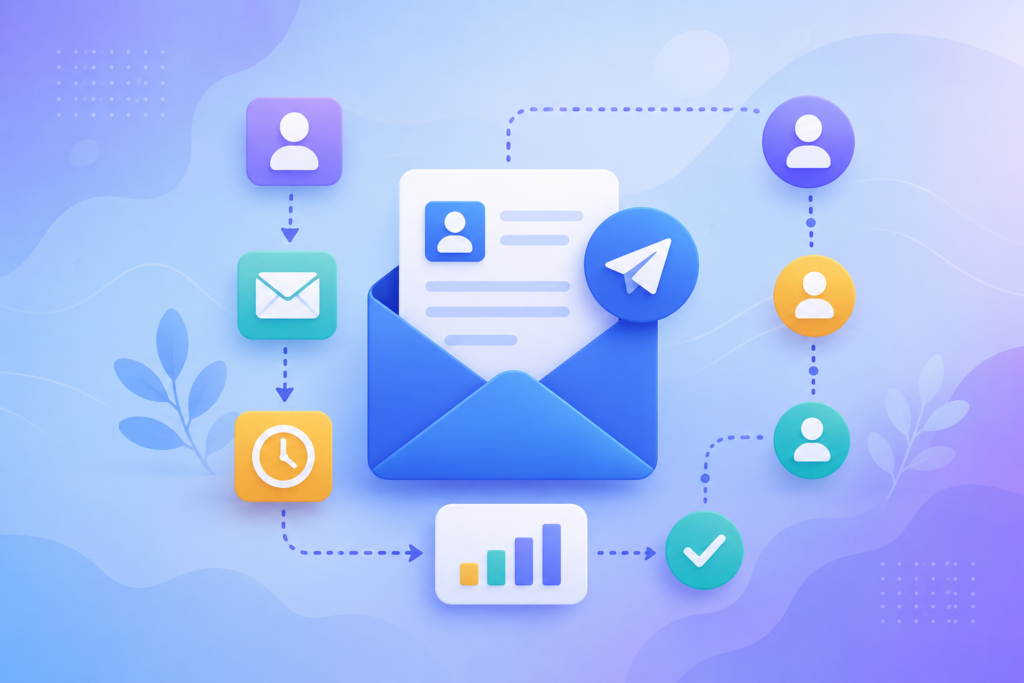
Email automation allows businesses to send relevant messages based on subscriber actions, timing, events, or lifecycle stages. Instead of manually sending every message, marketers can create workflows that respond to meaningful behavior.
Common automated sequences include welcome emails, onboarding campaigns, lead-nurturing sequences, abandoned-cart reminders, post-purchase education, review requests, renewal reminders, event reminders, and re-engagement campaigns.
A welcome sequence, for example, can begin by delivering the promised resource. The next email might explain how the business helps its audience. Another message can provide educational content, followed by a relevant product or service explanation. The objective is to build understanding rather than immediately overwhelm the subscriber with sales messages.
Automation becomes more useful when it responds to behavior. If someone clicks a product comparison, the next communication can provide additional information about that subject. If a customer purchases a product, promotional emails for that same product can be stopped while post-purchase communication begins.
Automation should never mean set it and forget it. Workflows require regular review. Businesses should verify that information remains accurate, timing still makes sense, customers are not receiving duplicate messages, and each automation contributes to its intended objective.
Effective automation combines technology with human judgment. Technology delivers the message at the appropriate moment, while strategy determines what the message should say and why.
Email deliverability refers to the ability of messages to reach the intended inbox rather than being rejected, blocked, or filtered into spam. It is a fundamental part of Email Marketing because excellent content cannot generate results if subscribers never receive it.
Email authentication is a major part of modern sending infrastructure. Google currently requires senders to personal Gmail accounts to use SPF or DKIM authentication, while senders delivering more than 5,000 messages per day to Gmail accounts have additional requirements, including SPF, DKIM, and DMARC. Email sender requirements
Sender reputation also depends on audience behavior. High complaint rates, invalid addresses, poor engagement, sudden volume changes, and repeated sending to uninterested recipients can create delivery problems.
Businesses should therefore monitor bounce rates, authentication status, complaint signals, engagement trends, and sending patterns. Old or inactive addresses may require a carefully designed re-engagement process rather than indefinite sending.
Deliverability is not controlled by one technical setting. It is the result of authentication, infrastructure, audience quality, sending behavior, content relevance, and subscriber engagement working together.
Google also provides guidance through Postmaster Tools for monitoring email delivery to Gmail users. Postmaster Tools and sender requirements
SPF, DKIM, and DMARC are important technologies used to authenticate email sending domains. They help receiving systems determine whether messages are associated with legitimate sending infrastructure.
SPF, or Sender Policy Framework, allows a domain to identify authorized email servers. DKIM, or DomainKeys Identified Mail, adds a cryptographic signature that receiving systems can use to verify the message. DMARC, or Domain-based Message Authentication, Reporting, and Conformance, builds on SPF and DKIM and allows domain owners to establish policies for messages that fail authentication and alignment checks.
Google recommends email authentication and explains that SPF helps prevent unauthorized senders from appearing to send messages from a domain, while DKIM allows receiving servers to verify that the domain owner authorized the message. Google also recommends setting up DMARC for the sending domain. SPF, DKIM, and DMARC authentication guidance
These settings should be configured carefully because incorrect DNS records can affect legitimate email. Businesses should document their sending platforms, domains, subdomains, and authentication records before making technical changes.
For organizations sending substantial volumes of email, authentication should be treated as essential infrastructure rather than an optional enhancement. It supports sender identity, protects domains from impersonation, and can contribute to better delivery outcomes.
Measurement turns email activity into an accountable marketing process. Without meaningful measurement, businesses may continue sending campaigns without knowing whether they are generating leads, sales, engagement, or customer value.
Useful metrics can include delivery rate, bounce rate, click-through rate, conversion rate, unsubscribe rate, complaint rate, revenue, revenue per subscriber, qualified leads, and return on investment. The appropriate metrics depend on the campaign objective.
Open rates can provide directional information, but they should not be treated as a perfect measurement of human attention. Privacy features and technical changes can affect open tracking. Clicks, conversions, purchases, registrations, replies, and other downstream actions may provide stronger evidence of engagement.
Attribution should also be handled carefully. A customer may interact with search, social media, paid advertising, direct traffic, and email before converting. Giving the entire conversion to one channel can create an inaccurate view of marketing performance.
A useful reporting dashboard should connect email metrics with business outcomes. Instead of reporting only that an email received a certain number of clicks, determine what happened after those clicks. Did they produce qualified leads? Did leads become customers? Did the campaign generate repeat purchases?
Measurement becomes valuable when it leads to decisions.
If a campaign underperforms, the next step should be to identify the likely cause and test a specific improvement.
Testing allows marketers to replace assumptions with evidence. Instead of debating which subject line, call to action, offer, design, or send time is better, marketers can test controlled variations and evaluate the results.
A/B testing can be used for subject lines, calls to action, layouts, offers, messaging angles, and other campaign elements. However, testing becomes less useful when too many variables are changed simultaneously. If the subject line, design, offer, audience, and timing all change at once, it becomes difficult to determine what actually caused the performance difference.
A better approach is to begin with a clear hypothesis. For example:
“A benefit-focused subject line will produce more qualified clicks than a feature-focused subject line.”
The test should then measure a metric related to that hypothesis.
Sample size and consistency also matter. Small audiences can produce unreliable differences, so marketers should avoid treating a tiny performance variation as a permanent winner.
Testing should include qualitative feedback as well. Customer replies, sales-team comments, support questions, and customer interviews can reveal why subscribers behave in certain ways.
A strong optimization process follows this cycle:
This turns Email Marketing into a continuous learning system rather than a repetitive publishing process.
Consistency does not mean sending an email simply because the calendar says it is time. It means establishing a predictable communication pattern that subscribers understand and find useful.
A content strategy can combine educational information, industry insights, customer stories, product information, announcements, practical tips, curated resources, promotional offers, and community-focused communication.
One practical approach is to divide content according to purpose. Educational emails can build expertise and trust. Product-focused messages can explain available solutions. Customer stories can demonstrate practical outcomes. Promotional emails can encourage action. Retention emails can help customers gain more value after purchase.
The content calendar should also reflect business priorities. If a company launches a new product, communication may temporarily focus on education, benefits, demonstrations, and launch information. Afterward, communication can move toward onboarding, customer success, feedback, and complementary products.
Consistency should also apply to brand voice. Subscribers should recognize the organization through its tone, vocabulary, visual identity, and communication style.
However, consistency should not become repetition. If every message sounds the same or promotes the same offer, subscribers may lose interest.
The goal is to build an email presence that subscribers recognize as useful, relevant, trustworthy, and worth reading.
Email Marketing and SEO can strengthen one another when they are treated as complementary channels. SEO helps attract people who are actively searching for information, while email provides a way to continue communicating with people who voluntarily subscribe.
For example, a business can publish an in-depth article targeting an informational search query. Visitors can then discover a related resource or newsletter subscription. After subscribing, those readers can receive additional educational content, case studies, tools, and relevant product information.
Email can also provide useful insights for content planning. If subscribers repeatedly click articles about a specific problem, that behavior may indicate strong audience interest. The business can then develop additional guides, FAQs, videos, case studies, or product resources around that subject.
The relationship works in the other direction too. A detailed article can become the foundation for an email campaign. Instead of creating completely new material for every newsletter, marketers can transform existing expertise into practical tips, short insights, summaries, and related recommendations.
Google recommends creating content primarily for people and emphasizes helpful, reliable, people-first content. Google’s people-first content guidance Google also provides its broader SEO Starter Guide for publishers seeking to make content easier for search engines to understand.
A connected content and email strategy allows businesses to extend the value of their expertise across multiple channels while maintaining relevance for subscribers.
Acquiring a customer is only one part of sustainable growth. After someone purchases a product, subscribes to a service, or begins using a platform, businesses have an opportunity to strengthen the relationship through useful communication.
Retention campaigns can include onboarding sequences, product education, usage tips, maintenance reminders, renewal notifications, loyalty messages, customer-only resources, feedback requests, and relevant recommendations.
The content should match the customer’s stage. A first-time buyer may need basic instructions, while an experienced customer may benefit from advanced resources or complementary recommendations.
Timing is equally important. A product education email immediately after purchase may be valuable. Sending the same message several months later may be less useful.
Retention emails should also avoid becoming a constant stream of promotional offers. Customers need reasons to remain subscribed even when they are not ready to purchase. Educational content, useful resources, customer support, and personalized recommendations can create value between purchases.
A strong retention strategy asks one central question:
How can this email help the customer get more value from the relationship?
When businesses consistently answer that question, Email Marketing can support loyalty instead of becoming another source of promotional noise.
Not every subscriber remains active forever. People change jobs, interests, priorities, budgets, and communication preferences. Some subscribers stop interacting because the content is no longer relevant, while others may have subscribed for a single resource and never developed a deeper relationship.
A re-engagement campaign provides inactive subscribers with an opportunity to reconnect. It may remind them about the value of the newsletter, provide a useful resource, offer communication preferences, or ask whether they still want to receive emails.
The language should remain respectful. Avoid guilt-based messaging or manipulative tactics designed to pressure subscribers into staying.
Businesses should also define inactivity carefully. One month without a click may not indicate meaningful disengagement for every industry. The appropriate timeframe depends on sending frequency, customer lifecycle, buying cycle, and audience behavior.
After a re-engagement sequence, consistently inactive addresses may be suppressed from regular campaigns. This can help maintain a healthier audience.
Re-engagement is therefore not simply about recovering subscribers. It is also about maintaining a cleaner and more engaged email audience.
Email marketers should treat permission and privacy as strategic priorities rather than simple legal requirements. Rules vary according to country, audience, business model, and type of communication.
For example, the UK’s ICO explains that electronic marketing rules under PECR can require consent for unsolicited marketing emails to individual subscribers. It describes valid consent as freely given, specific, informed, and unambiguous. ICO electronic mail marketing guidance
The ICO also explains that people must be able to withdraw consent and that businesses should maintain records showing how and when consent was obtained. ICO consent requirements
The United States has separate requirements. The Federal Trade Commission provides guidance concerning the CAN-SPAM Act and commercial email practices. FTC online advertising and marketing guidance
Businesses should therefore maintain clear records of subscriber acquisition, consent, preferences, and opt-outs. Signup forms should not hide important information, and unsubscribe mechanisms should be easy to locate and use.
Data minimization is also valuable. Collect information that has a legitimate purpose rather than requesting unnecessary personal details.
Compliance should be built into the Email Marketing system from the beginning instead of being treated as a correction after complaints occur.
One of the most common mistakes is focusing on list size instead of list quality. A large database may look impressive, but inactive, invalid, or unauthorized addresses can create engagement and deliverability problems.
Another mistake is sending the same message to everyone. Customers, prospects, new subscribers, and inactive users have different needs. Without segmentation, businesses often send irrelevant communication to large parts of their audience.
Poor frequency management is another common problem. Some companies send too many promotional emails, while others disappear for months and suddenly return with aggressive offers. Both patterns can weaken trust.
Technical mistakes can also damage performance. Missing or incorrect authentication, poor list hygiene, excessive sending to inactive addresses, and weak infrastructure can affect delivery.
Google’s sender guidance recommends authentication and provides requirements for Gmail senders, including SPF, DKIM, and DMARC requirements for qualifying bulk senders. Gmail sender requirements
Other common mistakes include:
Avoiding these mistakes can improve both performance and subscriber trust.
A strong Email Marketing program begins with a clear objective. Every campaign should have a reason for existing. That reason might be education, lead nurturing, customer activation, product promotion, event registration, retention, or another measurable business outcome.
The second principle is relevance. Use meaningful segmentation and responsible personalization to ensure that communication addresses actual customer needs.
The third principle is technical reliability. Configure email authentication, monitor delivery performance, maintain healthy lists, and investigate unusual bounce or complaint patterns. Google provides detailed guidance for email authentication, sender reputation, spam rates, and Gmail delivery. Google Email Sender Guidelines
The fourth principle is continuous learning. Test important elements, record results, review conversion data, and use customer feedback.
The fifth principle is trust. Be transparent about what subscribers are receiving, avoid deceptive claims, and respect communication preferences.
A practical framework is:
Strategy → Permission → Segmentation → Content → Automation → Deliverability → Measurement → Testing → Optimization
When these elements work together, email becomes a long-term marketing asset instead of a collection of disconnected messages.
Start by defining the business objective. Decide what Email Marketing needs to accomplish. The objective could be lead generation, ecommerce sales, customer retention, event registrations, or customer education.
Next, define the audience. Identify who should receive the emails and what their needs are. Create meaningful subscriber categories based on behavior, lifecycle stage, interests, or preferences.
Then establish the subscription value proposition. Explain what people will receive and why it is worth providing their email address.
After that, design the communication journey. Map the welcome sequence, educational content, promotional campaigns, onboarding, retention, and re-engagement processes.
Next, establish the technical foundation. Configure your email platform, authenticate your domain, test signup and unsubscribe processes, and establish monitoring procedures.
Create the content calendar after these strategic foundations are in place. This prevents the common mistake of creating emails simply because there is an empty space on the calendar.
Finally, establish reporting. Track metrics that connect directly to your business objective.
A successful strategy is therefore built before the first large campaign is sent.
Email Marketing is the use of email communication to build relationships with prospects and customers. It can support lead generation, sales, education, onboarding, retention, customer communication, and loyalty.
There is no universal frequency that works for every company. The appropriate schedule depends on audience expectations, industry, customer lifecycle, content quality, and communication purpose. Businesses should prioritize consistency and usefulness rather than sending emails simply to increase volume.
Buying an email list is generally a poor foundation for sustainable marketing. People on purchased lists may not have requested communication from your organization. The ICO states that organizations using bought-in lists need to verify that valid consent covers the organization and the specific electronic marketing method. ICO guidance on bought-in lists
Email segmentation is the process of dividing subscribers into meaningful groups based on characteristics, behavior, interests, purchases, engagement, or lifecycle stage. It helps businesses deliver more relevant communication.
Email automation uses software to send predefined messages based on timing, subscriber actions, or events. Examples include welcome emails, onboarding sequences, abandoned-cart messages, renewal reminders, and re-engagement campaigns.
SPF, DKIM, and DMARC are email authentication technologies. They help receiving systems verify legitimate email and reduce risks associated with spoofing and unauthorized sending. Google recommends email authentication and has specific authentication requirements for qualifying bulk senders. Google authentication guidance
Useful metrics include delivery rate, bounce rate, clicks, conversions, unsubscribes, complaint signals, revenue, leads, and return on investment. The most important metric depends on the campaign objective.
Use permission-based list growth, maintain accurate subscriber data, configure email authentication, monitor bounces and complaints, manage inactive subscribers, and send relevant content. Google also recommends using Postmaster Tools to monitor delivery information for Gmail users. Google Postmaster Tools guidance
Email technology should support strategy rather than replace it. Businesses may use email platforms for campaign creation, subscriber management, automation, segmentation, analytics, and reporting.
A smaller business may need newsletters, signup forms, basic automation, and analytics. A larger organization may require CRM integration, behavioral triggers, advanced segmentation, ecommerce integration, transactional messaging, and detailed attribution.
Integration is especially useful. Connecting email with a CRM can help sales and marketing teams understand subscriber activity. Ecommerce integrations can support purchase-based segmentation. Analytics integrations can connect email clicks with website actions.
However, adding more tools does not automatically improve performance. Every additional system creates dependencies and requires maintenance.
Before choosing an email platform, consider:
Technology should make the strategy easier to execute rather than making the strategy unnecessarily complicated.
Advanced Email Marketing begins with behavioral intelligence. Instead of treating subscribers as static database records, marketers can use meaningful actions such as purchases, clicks, downloads, product usage, preferences, and engagement patterns.
Predictive approaches can help identify highly engaged prospects or customers who may need specific communication. However, businesses should avoid excessive personalization that could make subscribers uncomfortable.
Lifecycle orchestration is another advanced strategy. Instead of creating disconnected campaigns, businesses can design a communication system where subscribers move between stages based on behavior.
A new lead might enter a welcome sequence, then move into educational nurturing. After a high-intent action, the subscriber could enter a more commercially focused sequence. After purchase, prospect communication should stop and customer onboarding should begin.
Dynamic content can also allow different subscribers to see different sections within the same campaign.
However, complexity should not become the objective. More automation, data, and personalization do not automatically produce better marketing.
The best advanced strategy is the one that uses data, technology, and customer insight to create a noticeably better experience.
Email continues to evolve as privacy expectations, artificial intelligence, authentication standards, automation technology, and customer behavior change.
Artificial intelligence can assist with content ideation, classification, personalization, testing, workflow analysis, and campaign planning. However, AI should not replace human judgment, expertise, fact-checking, brand oversight, or responsible data practices.
Privacy will remain another important consideration. Customers increasingly expect organizations to explain how their information is collected and used.
Technical standards will also continue to evolve. Google currently maintains specific sender requirements for Gmail, including authentication and unsubscribe expectations for qualifying bulk senders. current Gmail sender requirements
The future of Email Marketing is therefore not simply about sending increasingly personalized messages. It is about creating a relevant, trustworthy, technically reliable, and customer-centered communication system.
Businesses that build strong fundamentals today will be better positioned to adapt as customer expectations and technology continue to evolve.
The most important lessons from this guide can be summarized into a practical framework.
Build permission-based audiences. Grow your list through useful experiences and clear signup expectations.
Prioritize relevance. Use segmentation and responsible personalization to improve the subscriber experience.
Create useful content. Every email should have a clear purpose and provide a reason for the reader to care.
Use automation intelligently. Automate repetitive lifecycle communication while regularly reviewing workflows.
Protect deliverability. Maintain list quality and configure appropriate email authentication. Google’s official sender guidance provides current requirements and recommendations. official Gmail sender guidelines
Respect privacy and consent. Requirements vary by jurisdiction, so businesses should understand the rules that apply to their audiences. The ICO provides current guidance on electronic marketing under PECR. current electronic mail marketing guidance
Measure business outcomes. Do not depend entirely on vanity metrics. Connect email performance to leads, purchases, revenue, retention, and customer value.
Test continuously. Use controlled experiments and document what you learn.
Respect subscribers. A successful campaign should create useful interaction without damaging trust.
Create people-first content. Google’s Search Central guidance emphasizes helpful, reliable content created primarily for people. people-first content guidance
A strong Email Marketing strategy is built through consistent execution. There is no single subject line, automation, or software platform that can replace a thoughtful strategy.
Email Marketing remains a powerful way to develop direct relationships with prospects and customers because it enables businesses to communicate consistently, measure meaningful actions, and create experiences around different stages of the customer journey.
However, sustainable results come from relevance, permission, trust, and value, not simply sending more messages.
The strongest programs combine quality list building, thoughtful segmentation, useful content, persuasive but honest copywriting, lifecycle automation, mobile-friendly design, technical authentication, privacy awareness, testing, and disciplined measurement.
For Appledew, Email Marketing can become an important part of a broader digital growth system. When email works alongside SEO, content marketing, analytics, paid advertising, social media, and conversion optimization, businesses can create a connected path from discovery to conversion and retention.
The goal should never be to send the maximum possible number of emails.
The goal should be to send the most useful message to the right audience at the right moment.
Businesses that consistently follow this principle can build stronger customer relationships, improve experiences, increase conversions, and create a more sustainable marketing channel.
Prompt Text:
You are an expert consultant. Based on the blog post titled “Email Marketing”, provide a step-by-step, practical implementation guide. Include tools, best practices, common mistakes to avoid, and advanced tips. Assume the reader wants to implement everything discussed in this article effectively.
Call to Action:
Want our help implementing this? Just reach out to us via our website contact form: contact form